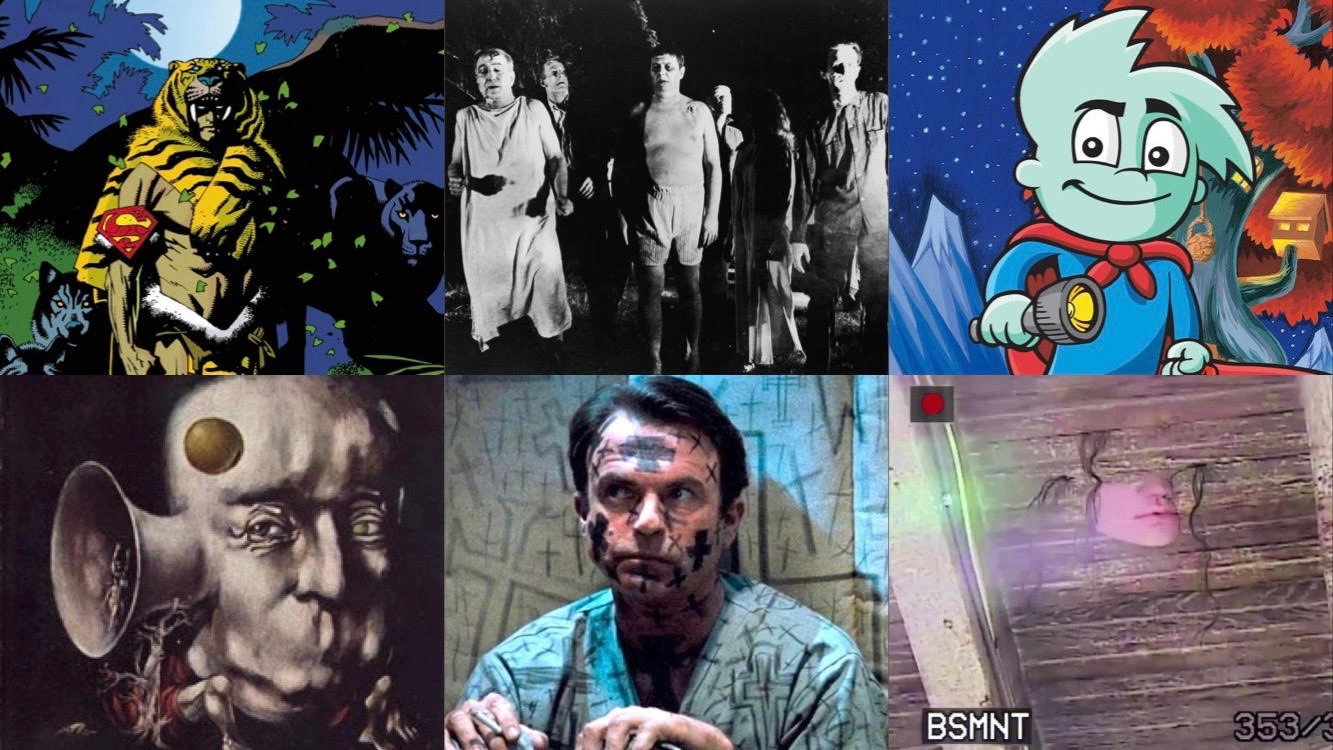
31 Nights of Secondhand Screenings
Arts
Oh, you thought this was over, didn’t you? You think the flame has been snuffed out on this Jack-o’-lantern? Well, I beg to differ! Sure, the crowds of trick-or-treaters have dwindled and the rain has washed away the fake cobwebs, but I’d be damned to wake Mariah Carey from her billion-dollar cryochamber this early. Take a load off with a bowl of untouched Halloween candy and enjoy a pillowcase full of mixed media, courtesy of Secondhand Screenings!
Under Wraps
Director: Greg Beeman
Disney Channel, Hallmark Entertainment
Released: 10.25.1997
I have a bone to pick with that ghastly Disney+. Aside from the sleazy “Terms and Services” loophole from first login or its disclaimer on heavy editing to its appeal to modern audiences, this all-knowing streaming service is mainly a fraud when it comes to its “collection.” Oh, you want the first Brave Little Toaster? I think you have to settle with Encanto Sing-Along. Tower of Terror? Why waste your time on that when we have Hocus Pocus 2? Do we have Under Wraps? Sure, the 2021 “original” or the sequel?!?! While you’re at it, enjoy our auto-play POV ride segments so your fat ass can get its fair share of pixie dust before your next trip to the HAPPIEST PLACE ON EARTH! Hallelujah! Holy shit! Luckily, another evil server comes equipped to dig up some childhood memories like a mummy from its tomb without any commercial interruption (sometimes) — YouTube, baby!
Under Wraps follows three friends: the rebellious horror fanatic Marshall (Mario Yedidia), scaredy-cat dweeb Gilbert (Adam Wylie) and the level-headed tough chick Amy (Clara Bryant). When their antique dealer creep of a neighbor croaks unexpectedly, a rumor circulates town that he was in possession of an Ancient Egyptian sarcophagus. While investigating the basement, the three get more than they bargained for by accidentally resurrecting a centuries-old mummy (Bill Fagerbakke, SpongeBob SquarePants) back from the dead! Now with a mystery unraveling when the sarcophagus goes missing, the three must return their new toilet paper-wrapped friend to his proper slumber before midnight on Halloween, or his soul will be reduced to dust.
It’s unclear if Under Wraps is actually a Disney Channel Original Movie, but that doesn’t stop the script from coming with its daily dose of DCOM camp. Some line deliveries land pretty cheese balls, making Degrassi look like a series written by Paul Thomas Anderson. However, there’s a simple charm that made this revisit hilarious to watch, especially from the weirdo neighbor kid who exaggerates every one-liner with that kindergarten no-fucks-given attitude. As a Halloween classic, it might be better to leave this one undisturbed in its digitalized ditch, but if you happen to still have a VHS copy lying around and want to pass down some spooky moods to the younger generation, I’d say go for it. —Alton Barnhart
Twister
Director: Jan de Bont
Amblin Entertainment
Released: 05.10.1996
What is the best monster movie you’ve ever seen? Universal Pictures’ rogues gallery of classic movie monsters like Dracula or The Creature from The Black Lagoon became grade-A industry standard for the horror genre. Japan went colossal with their havoc-reeking kaijus like Godzilla. The 1980s bred iconic slashers to the mainstream with Jason Voorhees or Chucky, subliminally messaging that the true horrors are in your own backyard. Yet now, we’re in the middle of a monster midpoint with their only manifestation of fear being deadbeat boyfriends, an orange unicorn and endless miles of office space! What if the monster can be the most grounded in reality, surely overlooked yet being a part of everyday life? What if the monster was Mother Nature?
The green goddess herself that gives life also has the ability to take it away in the most catastrophic of ways. It was she who froze wooly mammoths in the Ice Age, she who reduced Mount St. Helens to ashes and flooded homes in New Orleans during Hurricane Katrina…only for the government to put the final nail in the coffin by abandoning the entire state, but that’s another horror story to tackle. For seven-year-old me, Mother Nature created quite the devastating creature with spiraling clouds and an unstoppable force of destruction in Twister. Shut the fuck up, Glenn Powell! This doesn’t concern you!
Kansas meteorologist and slightly hinted at “wind-whisperer” Bill (Bill Paxton) is trying to bring some normality back into his life: becoming a weatherman for a local news station, getting engaged and trying to finalize the divorce with his ex-wife Jo (Helen Hunt). When a series of highly aggressive tornadoes start to make landfall, Bill is pulled back into the game of storm-chasing, especially when his experimental project for studying weather patterns nicknamed “Dorothy” is brought to life by his old rowdy team of scientists. However, there’s tension in the way his old colleague Jonas (Cary Elwes) competes for the same weather data with his own version of “Dorothy.” What follows is a blockbuster race against the elements where the winds of change can be too heavy to hold on through.
Twister was a phenomenal movie for me growing up — I strictly remember taking apart the VCR due to the contraption eating the tape after its tenth replay. It’s a flick of inner healing, pursuing the impossible and a kickass soundtrack courtesy of The Goo Goo Dolls and Van Halen (or Van “Hagar” depending on who you ask). It’s a shiny example of Hollywood disaster flicks that shows the darker side of a windy morning. Maybe it was a cheap excuse to praise this film by putting it in a Halloween media review, but they did have that drive-thru scene where they were showing The Shining. So it’s kind of a horror film…if you squint hard enough! —Alton Barnhart
Pajama Sam: “No Need to Hide When It’s Dark Outside”
Creators: Ron Gilbert, Rich Moe, Rhonda Conley
Humongous Entertainment
Released: 10.18.1996
In a household of a generational video game ban, yet zero supervision to late-night HBO, the chances of getting any console for birthdays or Christmases was as likely as getting the cure for cancer. That’s right — no PlayStation, no Xbox, not even a Wii to permanently shatter your flat screen if you were wearing the wrist straps during Wii Bowling. The reason: reports of children becoming translucent, pod-fingered basement dwellers were on the rise and my mom was not having that! If we did have something that involved fondling a joystick for hours at my house, it was rather a built-in plug-and-play or booting up the family desktop for some CD-ROM fun. We had stacks of point-and-click adventures ranging from the book fair relics of ISpy to the glitching poltergeist of Ned’s Nightmare. However, the absolute rock ‘n’ ruler of computer games was Humongous Entertainment delivering Y2K icons such as Freddi Fish, Putt-Putt and of course, Pajama Sam!
As he settles down for a goodnight’s rest, the little boy wonder Sam is stricken by fear that the personification of darkness itself is lurking somewhere in his closet. Armed with his trusty flashlight, signature “Pajama Man” lunchbox and a purple mask to seal his identity, Sam ventures into his closet and stumbles into The Land of Darkness — a bizarre, darkly-lit landscape where every object and fixture has a life of its own. On his way to Darkness’ treehouse headquarters, Sam is ambushed by some menacing trees, who steal his heroic possessions and scatter them all over the map of this nocturnal Neverland. Now, it’s up to you (and the help of some very friendly means of transportation) to collect his items and vanquish Darkness once and for all!
Now regarding its gameplay mechanics, Pajama Sam is a Simple Jack, but it might be asking too much from a game where its target demographic is ages 6+. Its runtime is based on trial and error, where clicking everything in sight will rather unlock the next step in your journey or at least play some ADHD-driven hilarity. Through clunky, colorful animations and storytelling that a paste-eater can understand, it’s not hard to figure out why Sam here has become the poster child for early computer development. Plus, there’s things in this world more terrifying than the dark. After wetting your bed from the thought of rigged elections and Marshal Law taking affect, we’re all merely adopting the darkness. —Alton Barnhart
This House Has People in It
Director: Alan Resnick
Adult Swim
Released: 03.15.2016
If you stayed up way too late to find yourself watching fast food talk, symbiotic poultry and Eric Andre destroying a talk show set, you don’t have an undiagnosed case of psychosis — it’s only the antics of Adult Swim. That’s right! When the sun sets on the Cartoon Network cul-de-sac, it’s time for Adult Swim to come out and play with their not-so-family-friendly entertainment. Those hours between dusk and dawn shucked various shows and shorts that were gut-bursting, mind-tripping and sometimes, just downright creepy. Nothing makes a viewer more uneasy than not knowing what comes next when the credits roll, especially when your fellow TV guide is lying to you. In Adult Swim’s regularly scheduled programming of “Infomercials,” their goodie bag of sketch comedy and horror vignettes has come synonymous with the online community. Classics like Too Many Cooks and Unedited Footage of a Bear still have conspiracy theorists up in arms, but my personal taste in dread comes from the hyper surveillance state mystery of This House Has People in It.
In a quiet suburban home (told through the several angles of surveillance camera system a family goes about their daily routine: mom is preparing cupcakes for the son’s birthday party, dad is taking care of the baby, grandma is watching her favorite program and the teenage daughter is…laying on the floor in the kitchen? All seems fairly normal, until they realize that their daughter is completely unconscious and slowly sinking into the hardwood floor. Slowly, but surely, anomalies all around the house begin to take shape: a spikey blue-haired humanoid runs across the backyard, faces are seen hiding in the attic and the whole family begins to lose their fucking minds!
“Big deal,” I hear you say, as you emotionlessly click the close tab button. However, it’s this 11 minute short that sparked a firestorm of detective work online, seeing how this family has truly dissent further into madness all under the watchful eye of an unknown presence. A Google search quickie for the surveillance company will uncover several unnerving clips, embedded codes and a whole cinematic universe. Whether This House Has People in It is a critique on alienation or for some reason Lynks Disease is totally up for debate, but in a world where every answer can be derived to your fingertips, it’s fun to have a good mystery once in a while. —Alton Barnhart
Night of the Creeps
Director: Fred Dekker
Tri-Star Pictures
Released: 08.22.1986
Night of the Creeps is a decidedly good time. The film is a pastiche of ’50s B-movies, complete with over-the-top sci-fi elements and horror effects.
In 1959, a frat boy leaves his fate behind to investigate a strange falling star in the woods, only to be taken over by an alien experiment. Fast forward to 1986, and lovestruck Chris Romero (Jason Lively) and his best friend, J.C. Hooper (Steve Marshall), are tasked with stealing a cadaver in order to be accepted into a fraternity and be noticed by Cynthia Cronenberg. In their attempt to complete the task, the boys break into a medical research room and discover the cryogenically frozen frat boy and accidentally release him. With a 1950s alien-controlled frat boy on the loose, the whole campus quickly becomes infested with creeps.
What I admire most about this film is its earnestness. In a world where meta-humor is the norm and characters are written to be aware of their genre and act above it, it is refreshing to see characters fully immersed in their story and truly interact with the world they reside in. The nods to the characters being self-aware are minimal and are delivered with actual reverence for the genre rather than a sense of superiority.
I also have to applaud the film’s ability to mix not only B-movie tropes with 1980s cheese, but also incorporate elements of slasher and zombie films without losing focus. It helps that the two main characters, while depicted as desperate losers, are actually likable and share great chemistry as a duo.
The film is also beautiful to look at with crisp cinematography and colorful visuals; gotta love an ’80s movie that starts with a black-and-white 1950s flashback. The makeup and effects, while silly, were also effectively creepy and impressive. There is a lot to love about this film, and you can tell that the people who made it were also passionate and excited to pay homage to an often overlooked era of horror. —Angela Garcia
The Initiation
Director: Larry Stewart
New World Pictures
Released: 04.06.1984
In the world of horror, no subgenre is more prolific and more dissected than the slasher. In truth, many would call the slasher subgenre the face of horror, and who could blame them; the most iconic franchises and characters in horror come from slashers and line the shelves of stores right before the Christmas overhaul. And yet, for as well-known as the slasher genre is, one can’t deny just how formulaic it is. Of course, that formula is most likely the reason it is so iconic, since it is so down to a science that it can be easily replicated. All you need is a group of rowdy teens or young adults, an unseen killer, a recognizable setting or event, buckets of blood and voie-la, a slasher movie has been made. Still, it is due to the easily repeatable formula that, when an unfamiliar element is added into the mix, the film is able to distinguish itself from its contemporaries. And for as generic as it is on the surface, The Initiation proves to have enough twists and turns to keep one invested.
The Initiation follows Kelly Fairchild (Daphne Zuniga), a sorority pledge who suffers from a recurring nightmare in which a strange man is burned in her home. She seeks help from Peter (James Read), a graduate student who performs a sleep study on her to see her brain activity during her sleep. Kelly also prepares to partake in the sorority’s initiation ritual, which involves breaking into her father’s department store and stealing the night guard’s uniform. However, unbeknownst to the pledges, a mental ward escapee is not too far behind them.
The Initiation works well as a simple slasher, but also has a soap opera quality that gives it a distinguishable identity. The setting of the department store also allows for some creative set pieces and kills. The only problem is that the film doesn’t fully sink its teeth into what makes it unique and also tends to meander in the middle. Still, if you are looking for a fun slasher with a twist you may or may not see coming, The Initiation has that in spades. —Angela Garcia
The New York Ripper
Director: Lucio Fulci
Fulvia Film
Released: 03.04.1982
The New York Ripper is required viewing for any giallo connoisseur – not because it evolves the subgenre but because it takes the most notable clichés found in the genre to ridiculous extremes.
Like any other giallo, the plot centers around the killing spree of a sadistic serial killer. After a woman’s decomposing corpse is found somewhere in New York City, Lieutenant Frank Williams (Jack Hedley) investigates the strange circumstances surrounding her death. When another woman is murdered similarly, it becomes clear that there is a serial killer on the loose — one who has a penchant for brutally slashing his victims.
In truth, this was a rather disappointing watch, while there were aspects of the film that I appreciated, namely the grimy depiction of New York. You can feel the dirt and the sweat of the seedy underbelly of the Big Apple. The gore effects were also impressive, visceral and unnerving. Despite those two highlights, the film left a lot to be desired. Perhaps its most egregious offense was the depiction of women. I went into this expecting a level of sleaze due to the subgenre’s history with women; however, Fulci’s oftentimes degrading view of women was on full display in this one. The sexual moments of the film are directed with little to no eroticism, so it goes from being perversely voyeuristic to completely ridiculous. The film also lacks a real sense of focus, jumping from character to character so that you can’t find yourself attached to anyone, and the notorious giallo dubbing does not help either.
The New York Ripper is not the most visually striking nor the most compelling mystery; in fact, if you are already familiar with how giallo films work, you can solve it pretty easily. Although considering that neither Dario Argento directed it nor Daria Niccolodi was in it, the mystery might have a few twists and turns. However, rather than rooting for any character, you’ll just wind up rooting for the movie to end. —Angela Garcia
Night Whispers
Author: Charles Veley
Doubleday
Released: 01.01.1980
When I first walked into Central Book Exchange a few weeks ago in the hopes of finding some vintage horror, Night Whispers was exactly the sort of book I was hoping to find. The well-loved cover promised a tale complete with “a mysterious cult!” “erotic, wild orgies!” and, of course, a ton of “BLOOD!”
Charles Veley’s novel wastes no time bringing readers into a fever dream of a story — almost every chapter is written from a new character’s point-of-view (some of which we only hear from once). It makes for a shaky start, but as the story progresses, we begin to see how the through-lines of memory-erasing and bloodthirsty cult The Gathering have infiltrated those with connections to Madison Hospital, a small, upscale hospital on the west side of Manhattan. There’s our heroine, Dr. Jane Weston, who is plagued by so-called “night whispers,” convinced she’s losing her mind but refusing to let that stall her life-changing advancements in obstetric surgery. Ted Sanford, the hospital administrator with a chip on his shoulder, struggles to keep up the hospital’s pristine image as patients are violently attacked and begin to mysteriously disappear. Relentless reporter Maryanne Delviccio knows somewhere in the middle of all of this chaos is an earth-shattering news story, but she just can’t quite figure out (or rather, remember) how to put all of the pieces together.
All in all, I had a blast reading this novel. It’s distinctly ’80s, combining a bit of sex, danger and of course, cocaine! With its age comes some typical problematic elements (why are we describing every character as either “healthy” or “obese?”), but if you can get past this and some other blatant stupidities on behalf of the main characters, Night Whispers is a fun and provocative vintage horror novel that is sure to entertain you this spooky season! —Anna Walker
I Have No Mouth, and I Must Scream
Author: Harlan Ellison
IF: Worlds of Science Fiction
Released: 03.1967
Considered somewhat of a cult classic, I Have No Mouth, and I Must Scream is a short story written in 1967 that is just as haunting as its title.
Author Harlan Ellison writes of a post-apocalyptic world in which WWIII supercomputer AM has gained sentience, killing all but five humans in revenge for his creation. Ted, our narrator, holds nothing back when describing the torment he and the other chosen humans live in. AM keeps them alive simply to torture them, finally forcing them along a journey of biblical proportions (burning bushes, earthquakes, locusts, etc.) in hopes of finding a morsel of food to eat, only to find that they have no tools to open the canned food once their voyage is complete. With that, Ted spouts AM and uses stalactites to slaughter his co-sufferers, therefore ending their eternal suffering and thoroughly pissing off his electronic captor. AM turns Ted into an amorphous creature as punishment, and his fate is sealed. Ted no longer has a mouth, and therefore, no way to express his anguish.
The tale is a gnarly one, but pretty on the nose in terms of forewarning about the dangers of giving computers sentience…cough, cough. If for some reason you wanted another tale of technology gone too far to make you want to crawl out of your skin, I Have No Mouth is the novella for you. —Anna Walker
Doki Doki Literature Club!
Creator: Dan Salvato
Team Salvato
Released: 09.22.2017
The last time I seriously played what you could consider a video game was after Minecraft Pocket Edition first came out. Since then, I haven’t wanted to “waste time” on video games (as I scroll endlessly through TikTok), and I definitely don’t gravitate towards anything remotely anime-related. So when my friend recommended Doki Doki Literature Club!, I didn’t have high expectations.
It promised to be a psychological horror game, but its aesthetic seemed the opposite: super cutesy and cartoonish. In fact, after my first hour of gameplay, I had almost given up because nothing remotely spooky or relatively exciting had happened. My character had gone to an after-school literature club like four times and written a few poems, but that seemed to be all there was to the game. That was, until the cracks began to show.
Yuri, a literature club member and awkward introvert type, seemed to show a strong interest in knives, and Sayori, my character’s best friend since birth, started to behave erratically. The first “part” of the game actually ended with my character finding Sayori after her apparent suicide. So much for being boring and cutesy. From there, the screen claims the game has ended, but if you click “new game,” it seems to restart from the beginning of the story, minus Sayori’s character, and with a few new “glitches” that happen.
In this go-round, character’s personalities seem to be amplified, the poems that are shared are creepier, and weird text seems to cover up what other characters seem to be programmed to say. In the end, it’s revealed that Monika, the president of the literature club, has been in charge of the game the entire time, and wants my character all to herself. So much so that I spent almost an hour “staring into Monika’s eyes” as she monologued about her love for my character. I was getting so annoyed that I looked up a YouTube walkthrough, where I learned you were supposed to “delete” Monika’s character file from the fake computer screen you begin the game with.
Overall, I found the game clever and relatively interesting, but not nearly as scary as I was expecting. It did, however, reignite my interest in video games, and I’d like to explore the genre more. It may be time to wake my Sims up from their 10+ year slumber… —Anna Walker
The Coven
Author: E. Howard Hunt
Fawcett
Released: 01.01.1972
If one was to judge a book by its cover, one would expect The Coven to be a mysterious vision of vintage horror, filled with the occult, witchcraft and beautiful women. In fact, it aims to include all of these elements, but beautiful women are really the only thing it succeeds in describing, and not even all that well.
The novel was penned by E. Howard Hunt, a former Watergate conspirator (which should have been my first red flag), and read like an HBO’s Mad Men character tried to write a noir detective thriller. It’s clear the author is familiar with the political landscape of Washington DC in the 1970s, but as for the occult, that’s another story entirely. Hunt blends elements of Voodoo, witchcraft, and cults in a way that can only be described as sloppy and uninformed; and not to mention racist as hell.
The main character quite clearly seems to be a caricature of the author himself, a retired lawyer who spends his days consulting on high-profile court cases, having women throw themselves at him, and drinking Bushmills on ice every five seconds. Seriously, did they do ad placements back then? The whiskey brand is mentioned like every other page.
Did I enjoy this book? Not particularly. Could I put it down? No way. It was a very quick read, and even with its long list of failings, I found myself racing through this trainwreck just to see how it would end (spoiler alert: pretty anticlimactically). I also found myself curious to try a cold glass of Bushmills… —Anna Walker
Night of the Living Dead
Director: George A. Romero
Image Ten
Released: 10.04.1968
When I first saw Night of the Living Dead, my dad walked in (as dads do) and said, “I can’t even be here! This movie freaks me out.” I don’t think it was that exactly, but it was something to that effect. I was 18 watching it in 2023, and it wasn’t anything to me besides an excellent B-movie. I tend to feel that way about a lot of horror things my dad shows me. The list of horror media he showed me is mostly movies from the ’50s and ’60s. He has a particular love for the television of his youth, so I was shown many episodes of The Twilight Zone and Night Gallery — both brilliant shows. All that’s to say that my dad was young when those things were coming out, and they freaked him out. It’s funny to see how desensitized audiences are today. To scare my generation, you would need excessive gore, mutating bodies, deep psychology, cheap jump scares and the full “works.” All it took to scare my dad was a good story and some horrifying implications.
That’s not to say Night of the Living Dead isn’t visceral. In fact, Night of the Living Dead may be the spark that ignited the excessive fire of today. The dead gnawing on animal innards and kids tearing into their mothers’ necks, all while being cooped up in a house surrounded by the dead, doesn’t resolve bigotry or deceit. It doesn’t unite us against a common enemy. I don’t want my initial rant to sound like “movies have gotten so bad!” because they haven’t. Holding that position reveals how few new movies you bother seeing in a year. Rather, I’d like to point out that the success of simple, character-driven horror movies like Obsession is proof enough that people are beginning to dislike horror in excess.
I believe we owe zombies to George A. Romero. All uniquely “zombie traits” were invented by Romero: the cannibalism, the headshot death, the shambling, the realization that man is the monster — that’s Romero. If you like The Walking Dead or 28 Days Later, you owe your love to him.
Ironically, this movie may be most remembered for its activism: Romero’s colorblindness in the casting and portrayal of Duane Jones as the film’s protagonist, Ben, who would be the first Black actor to lead a horror film. Ben is competent, smart, interesting and more than willing to smack someone around. He’s the only character you’ll come out of this rooting for. This film was preceded by the assassination of Martin Luther King Jr. and the creation of the 1968 Civil Rights Act, as America was in the thick of high racial tensions. Couple that with extreme violence, and you’d be certain of its controversy for its time
Why is any of that ironic? Romero had written the role for a white man and did nothing to change the script to adapt to a Black lead. Jones argued that it might be controversial for him to smack a white woman on screen. Romero rejected the change, thinking it would be more progressive to let him do it. He later expressed how ignorant that was.
Anyway, Night of the Living Dead is an all-time great movie that everyone needs to see now. —B. Allan Johnson
House
Director: Nobuhiko Obayashi
Toho Eizō
Released: 07.30.1977
Experimental commercial director Nobuhiko Obayashi was approached by Toho to produce a film to compete with America’s Jaws. Obayashi came back with the script for House. No filmmaker wanted it, thinking it would end their career. The studio denied Obayashi the opportunity to direct, but allowed him to announce the film anyway. Obayashi decided he would prove his ability to direct the story, leading to a manga, radio play, and soundtrack for the film that hadn’t even started production. Eventually, the studio gave in, allegedly telling Obayashi that they were tired of losing money on comprehensible films, so why not give his totally incomprehensible script a shot.
Gorgeous (Kimiko Ikegami) takes her classmates to her estranged aunt’s house to spend their summer break, but the house is not what it seems.
House is bonkers, being experimental filmmaking at its finest. There is nothing pretentious about it. All Obayashi wanted to do was make an entertaining film. You certainly can overintellectualize House, and that’s a good problem to have. It’s better to be given the opportunity to analyze a film’s themes than to be given a puzzle with a singular solution. Scene after scene you will find yourself wondering how this was made at all. Its leads are eaten by pianos and futons and chandeliers, and watermelons become decapitated heads.
Those wild and imaginative ideas came from Obayashi’s then pre-teen daughter, Chigumi Obayashi. She decided it was scary for a house to devour girls, and all her fears seem to revolve around that. The piano and futons and watermelon all came from Chigumi. The childishness of those ideas make the film so endearing and unpredictable. This movie goes in such outrageous directions and uses dream-like imagery that the shape of the film feels totally abstract.
Its cast is great! None were established actors when the film was shot. They were all models Obayashi had worked with on his commercials. And, man, they all have great names: Gorgeous, Prof, Mac, Kung-fu, Fantasy, Melody, Sweet. They’re all so likeable and what they go through is made so much worse by that.
Of all films you could watch from this series of second-hand-screenings, House should be at the top of your list. Watch it, become immersed in its insanity, and enjoy the ride. —B. Allan Johnson
Ed Wood
Director: Tim Burton
Touchstone Pictures, Tim Burton Productions, Di Novi Pictures
Released: 09.30.1994
When I selected Ed Wood for this year’s Secondhand Screenings, I was mostly excited to share with you a film that celebrates b-horror cinema. I was trying to prove that, in spite of what I’ve said about the horror genre, it’s worth loving. I was not expecting to be rendered emotionally vulnerable by it on this second viewing.
Ed Wood is a (somewhat) true story about the worst filmmaker of all time. Edward D. Wood Jr. struggles to succeed in his artistic endeavors. His luck turns around when he befriends legendary actor Bela Lugosi, who agrees to work in Wood’s B-movies.
Ed Wood loved comics and pulps and horror movies. He had insane stories running around his head, and he took all of them seriously. He was surrounded by freaks and geeks. He made easy friends with queer folks and psychics and monster-men. Ed himself loved to cross-dress and had an anora fetish, but it’s never treated by anyone he loved as a point of contention or outstanding in any meaningful way. This movie doesn’t approach these people as “freaks and geeks.” That’s just Ed and those are just Ed’s friends.
Tim Burton’s posturing tends to get on my nerves at a certain point. There are only so many black and white candy cane stripes I can see before it gets tiring. Ed Wood stands out as particularly special. Burton doesn’t overwhelm you with his aesthetic and instead playfully imitates B-horror. It’s a real tribute to the 50s, but more so a tribute to the act of creating. The film uses Orson Welles (played by Vincent D’Onofrio but voiced by Maurice LaMarche (the brain from Pinky and the Brain) to posit that you have to create unashamedly and without compromise. A great moral indeed, but more importantly, I think Ed Wood wants to tell you that you must make shit. If you’ve ever taken part in a student film or some friend’s terrible script, you will have been an Ed Wood. Creation isn’t about making something good; it’s about sharing it. Otherwise, why did you create it? You will have been told, I’m sure, that you must create for the sake of creating, and that’s true. You should be satisfied with the making, but taking that train of thought to the end of its track reveals that it shouldn’t make a difference whether or not you share it; just be happy to have done it. Wrong. Sharing it is most of the fun, even if it’s to boos and tomatoes. Leave your mark and try your best to be proud of it. Ed smacked his head against something for so long and so intensely, only to get nothing in return. He just loved his movies.
Johnny Depp reminds me that he’s actually pretty good at acting, but he’s gone the route of the Cage, selling his insane talent for pennies. Doesn’t that Ebenezer movie look terrible? Man, too bad we lost him. He could’ve been one of the greats. Don’t forget: Poor finances ruin a legacy. Anyway, Martin Landau sells Lugosi perfectly. Bill Murray is a queen. I love everyone in this, especially its extended cast.
Go make stuff! Be creative! Fail! Fail your entire life if you must! Just don’t stop creating and sharing! In an age of dull artists and hyperironic audiences, be earnest. Make something with all your passion and stand by it. We may make fun of twelve-year-olds sharing their My Hero Academia fan art, but that is honest-to-God passion and persistence. Please get a hobby. I’ve been bored, and I’ve been Ed Wood and I choose Ed Wood every time. —B. Allan Johnson
Blow Out
Director: Brian De Palma
Viscount Associates
Released: 07.24.1981
If Hitchcock was doing it in the 80s, he would’ve been Brian De Palma. De Palma loved sex and blood and perversion and everything taboo. He expressed interest in filming the first X-rated Hollywood film (the studios never wanted that, though). De Palma was exploitative, but he never took it too far. As tasteless as his movies can feel, he never wastes your time with shock.
Blow Out is about a sound artist for B-horror films. In his search for the perfect scream, he uncovers a political assassination that would change the way America would see its democracy.
Blow Out is unbelievable. Every scene is the best shot scene you’ve ever seen in any movie. The loss of the split-diopter may be worse for movies than the loss of film stock. De Palma casually whips out insane visual techniques. No one scene is any more boring or exciting than the last. Every scene is engaging and dripping with intrigue. Oh my GOD! If you haven’t seen this movie, how can you really say that you love movies? How can you say you love movies if you dislike De Palma? He practically reinvented the art form. I said this last year about Phantom of the Paradise, but De Palma never stooped to camp – he WAS camp. Your favorite piece of shit camp masterpiece is nothing compared to Carrie or Scarface. It pales in comparison to Blow Out. In fact, your favorite Hollywood films pale in comparison to Blow Out. Blow Out should be remembered in the same category of thrillers as The Conversation or Taxi Driver. It captures that paranoia perfectly.
Maybe more famous than the movie (Blow Out lost unbelievable amounts of money) is the fact that it led to John Travolta’s casting in Pulp Fiction. I’ve never held Travolta in high regard, but Blow Out is proof that, at some point, Travolta had the right stuff. Nancy Allen (Carrie, Robocop) based her performance on a rag doll. She is so fragile and meek, but there’s something dark bubbling under the surface. She knows too much and is smart enough to know not to say anything. John Lithgow (Shrek, Terms of Endearment) is nasty in this. He is privately perverse and degenerate. He’s the fixer for the ultra-elite and he takes great pleasure from his work.
Anyway, I love Blow Out and you will also probably like Blow Out, so watch Blow Out immediately. —B. Allan Johnson
The Tingler
Director: William Castle
Columbia Pictures
Released: 07.29.1959
Recently, I was roller skating with my friend Salem, and “Thriller” by Michael Jackson featuring Vincent Price came on. Everyone knows who Michael Jackson is, but I was that many days old when Salem taught me about Vincent Price, an actor known for his work in old horror movies such as Edgar Allan Poe adaptations. When I saw that one of Price’s films, The Tingler, was playing at The Broadway, I had to experience his work for myself.
The Tingler stars Price as a doctor working to uncover the titular creature, a centipede-looking thing that grows on the back of one’s spine as they experience terror. The Tingler is extremely powerful but has a fatal flaw, as it shrinks in size when exposed to the sounds of screaming. If only the doctor could examine someone at the peak of terror without the interference of screaming. Conveniently, the doctor recently met a mute woman whose husband, for some reason, hated her enough to scare her to death with a series of very 1950s frights. After the doctor extracts The Tingler from the dead woman’s body, chaos ensues as it is then let loose in a movie theatre, but it’s more funny than scary since you can clearly see the string dragging it around, and it remains completely rigid, not showing any signs of possibly being alive.
I was pretty enthralled while watching this movie, if for no other reason than the charming way people looked and sounded pre-1960. The movie resolved when The Tingler was finally captured and returned to its host. The plot then twisted to reveal that instead of subduing it as was planned, this only made it more powerful, as it now had full possession of the dead woman’s body, who wanted revenge on her husband. And I was ready to get right back into it, until I remembered that these B films don’t really go that deep and are content to end on a cliffhanger. It was still an amusing ending if not fully satisfying. –Braxtyn Birrell
A Little Less Sixteen Candles, A Little More Touch Me
Fall Out Boy
Vevo
06.16.2009
To be transparent, I am writing this review because as I was posting this article, I realized we only had 30 reviews, and that just won’t do. So, consider the 2009 music video for Fall Out Boy’s “A Little Less 16 Candles, A Little More Touch Me” review #31. Also, honorable mention to Panic! At The Disco’s “It’s Almost Halloween,” which I almost went with until I remembered this existed. I never grew out of my emo phase. I know I have seen this music video at least 10 times, as I discovered it 10 years ago and watch it once a year as a Halloween tradition, but it’s probably closer to 100 times.
This seven minute-long video starts with a group of vampire hunters (Andy Hurley, Joe Trohman, Patrick Stump) who are shown up in their attempt to hunt some vampires by a vampire-hunting vampire (Pete Wentz). Vampire Pete joins forces with the hunters to track down those who turned him: “Those who walk in the shadow places forgotten by the sun. He hates all of them, but they live in fear of him.” Then the song starts, showing Vampire Pete doing karate and literally bouncing off the walls while he shreds the bass.
The music cuts out as a group of Sinners-esque vampires in bowler hats, three-piece suits and white gloves show up, led by Brendon Urie. A fight that is simultaneously hilariously awkward, beautifully choreographed and fucking epic ensues. In the end, the bad guys win, as Vampire Pete is shoved into a police car, and the police are… vampires!
I miss Fall Out Boy. I know they’re still around, but I miss 10-word titles that have nothing to do with the song and lyrics that read like poetry. “I set my clocks early ’cause I know I’m always late” lives in my head rent-free because it’s so counterintuitive that it works. They just don’t make Fall Out Boy like they used to, and nobody is doing music videos like old-school FOB, either. –Braxtyn Birrell
The Mothman Prophecies
Director: Mark Pellington
Lakeshore Entertainment
Released: 01.25.2002
So, here’s the thing: I love cryptids. All of ’em. From the weirdly realistic ones to the ones that are clearly just a guy in a raccoon costume. To me, cryptids are warning signs, and I think we should revere them and do what they say. You, dear reader, may already be backing away slowly. “What do you mean there’s a realistic side?” Fair. But can you blame me? I’m from Utah, where the desert is crawling with old Native legends. Then I spent most of my twenties on the East Coast, where the mountains are ancient, the forests are thick, and every town has a story somebody’s grandma won’t stop telling. I never stood a chance.
So picture it. One minute you’re a beautiful redhead house hunting with your husband and christening a closet like the lovebirds you are. The next, you’re wrapping your car around a tree, swearing you saw something, and waking up in a hospital with a brain tumor. Two weeks later, you’re dead. Rough real estate market… Unfortunately for the cosmos, your husband is a top reporter at The Washington Post. And reporters do not let things go. That husband is John Klein, played by Richard Gere at peak Concerned Richard Gere. Two years after his wife’s death, he sets out on a late-night drive to Richmond and somehow ends up hundreds of miles away in Point Pleasant, West Virginia, with no idea how he got there. Normal stuff. It doesn’t take long to figure out something pulled him there, especially once he meets the town cop, Officer Connie Mills (Laura Linney, doing her best with a man who keeps saying “something is wrong”). The locals have been seeing things for two months. Tall things. Red-eyed things. Things with voices like fried electrical waves on the phone that know too much.
Have you ever wanted to take a long walk through West Virginia with eerie music swelling and a cameraman behind you who is clearly having a breakdown? Congratulations, this is your movie. The score sounds like a 90s cop procedural that wandered into a séance. The editing alternates between rapid-fire cuts and shots so long you start checking over your own shoulder. You’d swear you’d stumbled into a gallery opening on the Lower East Side in 1997: red filters, infrared, extreme close-ups of trembling eyeballs and random body parts, and, every so often, a moth. Not the Mothman. Just a regular moth. Doing moth things. Menacingly. Personally, I find the Mothman hilarious. A few years ago, my friends and I spent a month in our tiny Brooklyn apartment completely consumed by this man-moth who lived in the trees of West Virginia and apparently showed up right before disaster like a very tall, very winged weather alert. I blame the Appalachians. Those mountains are older than bones, and you could not pay me to spend a night in them.
So when I was scrolling Netflix for weird movies for this series and saw The Mothman Prophecies, hells yes, I hit play. Not only is it Mothman, but it’s got Richard Gere AND Laura Linney?? Huh! Could not have predicted that duo. The Mothman probably could have, you know, ’cause of the whole premonition thing. And here’s the best part: the movie never tells you what any of it means in the end. A bridge explodes, people die, and they just kind of go, “okay, well that happened,” and it ends with another long pan out from our favorite camera guy. It’s loosely based on real events (John Keel‘s book about the 1966–67 sightings), and like the real story, nobody ever figures out a damn thing. Is he a demon? An alien? A bug with an agenda? A premonition of death with excellent posture? The film just shrugs, shows you another moth, and goes, “Hey, you’re maybe gonna die!” Nice. Like I said, love cryptids. —Ella BakerSmith
Interview with the Vampire: The Vampire Chronicles
Director: Neil Jordan
The Geffen Film Company & Warner Bros
Released: 11.11.1994
Whether you’re a fan of classic Gothic literature, Tom Cruise, or the modern AMC production, you may already be familiar with the ’90s film adaptation of Anne Rice’s debut novel, Interview with the Vampire: The Vampire Chronicles. If so, this review may not reveal anything new to you, but it would be a disservice to disregard the impact of this dreadfully dazzling release as we depart from the final days of October. Although queer subtext in vampiric media is nothing new, Interview with the Vampire is now regarded as one of the most revered queer-coded vampire films. For those who have yet to see Interview with the Vampire, your curiosity may already be piqued. For others, you may be more attracted to the period costumes and fantastic features from beloved performers.
The story begins late at night in an office building in San Francisco, where we meet a young reporter who’s been offered the once-in-a-lifetime opportunity to interview with a 200-year-old vampire, Louis (Brad Pitt). Louis shares that he entered the vampiric world as a mortal man and plantation owner grieving the loss of his wife and newborn child in 1791. After a drunken rendezvous at the edge of death, Louis is transformed into a vampire by the charismatically sadistic Lestat (Tom Cruise). Condemned to immortality, Louis struggles to grapple with his conscience and his craving for human blood, while Lestat joyfully embraces their newfound companionship. Their turbulent relationship grows even more complicated when they turn a young girl named Claudia (Kirsten Dunst) into a vampire, trapping her in a child’s body for all of eternity and proclaiming her as their daughter. What follows is a twisted imitation of family life, where affection, jealousy, and cruelty intertwine. Beneath its lavish candlelit interiors and haunting atmosphere lies a story about loneliness, humanity, and the desperate need for companionship. Vampire lovers already relish the fact that the majority of vampires are depicted with a true craving for love, not just blood. Given that this craving does not discriminate, the intimacy between Louis and Lestat extends far beyond conventional friendship, with their possessiveness, jealousy, and domestic tensions resembling those of a troubled marriage. Claudia’s lust for revenge further complicates their unconventional household and spurs a search for other immortals, revealing how easily love can turn to an entanglement with power. Ultimately, by the end of the film, Louis walks the world alone, left to tell his never-ending tale.
With the plot in mind, the film’s Gothic aesthetic remains one of the most attractive aspects of the film. Elaborate period costumes, shadowy interiors, and decadent scenes make immortality appear all the more alluring, despite the emphasis on the tragic destiny of a deathless existence. Ultimately, the film’s queer undertones, morally ambiguous characters, and decadent atmosphere have assured its place in the world’s most memorable vampire media. Whether you’re revisiting the film as a longtime lover or experiencing its blood-soaked drama for the first time, Interview with the Vampire offers plenty to sink your teeth into. As the season of spookiness comes to a close, few films feel more fitting for a final October viewing. After all, there is always something undeniably dreadful about a story in which love can outlive death, yet never quite escape its consequences. – Juno McKell
The Haunting Hour: Don’t Think About It
Director: Alex Zamm
Universal Studios Family Productions, The Hatchery, and Steeltown Entertainment
Released: 09.04.2007
I’m not a big horror movie fan. Being scared is just not a favorite feeling of mine; I’m anxious enough already. While I can’t blame the anxiety thing on a direct-to-DVD movie that aired on Cartoon Network, I can blame it for my mildly traumatizing introduction to the horror genre. R. L. Stine’s The Haunting Hour: Don’t Think About It is a children’s movie that follows Cassie (Emily Osment, Hannah Montana: The Movie, Spy Kids 2: Island of Lost Dreams), a goth girl whose family just moved to a new neighborhood. Predictably, Cassie is misunderstood by her parents, easily annoyed with her little brother Max (Alex Winzenread) and picked on at school.
After a strangely long walking montage, Cassie stumbles upon a Halloween store down a dark alley. Inside, she’s greeted by scary decorations, a tarantula jump scare, and a creepy shopkeeper who persuades her to buy a book titled “The Evil Thing” for the bargain price of $5. Despite a clear warning to not read the book out loud, Cassie ends up reading it to Max to scare him after he accidentally turns off her computer in the middle of writing her term paper. The book describes a gruesome two-headed monster that carries slimy eggs on its back, hunting humans to feed to the babies when they hatch. Luckily, the monster doesn’t actually exist. Well, as long as no one’s thinking about it.
Seven-year-old me was horrified by this movie. Even now, the monster is terrifyingly awesome to look at, especially considering that all the effects are practical. It could belong in an actual horror film. I remember being unable to shake this movie for days, constantly worrying because I was thinking about the monster, which, as the book warned, makes it real.
Thankfully, despite my nervous thinking, The Evil Thing never came to feed me to its equally freaky-looking babies. Well, at least for now, because I’m still definitely thinking about it. – Margaret Pugh
Memories
Directors: Katsuhiro Otomo, Koji Morimoto, Tensai Okamura
Shochiku
Released: 12.23.1995
Classic anime films like Akira (1988, Katsuhiro Otomo), Ghost in the Shell (1995, Mamoru Oshii), The Animatrix (2003, Koji Morimoto) and Perfect Blue (1997, Satoshi Kon) all hold a special place in the hearts of anime fans. What they all have in common is that they revolutionized the boundaries of animation: hand-painted cyberpunk backgrounds, psychological storytelling, and unforgettable ambient industrial soundtracks. Created through the blood of artists, these films are labors of love that modern anime productions cannot compare to. I was doomscrolling through Facebook Marketplace and, to my surprise, I discovered that these godfathers of anime had all collaborated on a film which I had never heard of: Memories (1995).
A guy named Kyle, a film nerd like me, understood my excitement and sold it to me for ten dollars. I was filled with overwhelming joy, then embarrassment when I remembered that I didn’t even own a DVD player anymore. After all, nowadays everything we watch has gone digital and we hardly own any physical media. It was refreshing to own my own physical copy and watch a film without a single ad interrupting my experience. To my heart and soul, it was food.
The film consists of three stories: “Magnetic Rose,” “Stink Bomb,” and “Cannon Fodder.”
It was like a drink flight, which, if I could describe them on a menu as drinks, it would be like this:
Magnetic Rose: A rosy and rum old fashioned. Rustic in color. My absolute favorite story. A Sleeping Beauty-esque horror story set in deep space. A group of space junk freighters responds to an SOS signal, only to discover a ship that lures its victims into a Venus flytrap. Controlled by the lingering consciousness of a deceased opera singer, now existing as an artificial computer, she manipulates the memories of her victims and draws them into a false reality of romance. Unable to let go of her own grief and past memories, she continues to recreate the world she once knew.
Stink Bomb: A funky tropical jackfruit margarita. A smoky salted Tajín rim. This film is a satirical body horror. A sick lab technician accidentally becomes a deadly walking biohazard after ingesting an experimental drug from his workplace… Unaware of his own condition, he unknowingly kills everyone around him with his odour. With good-hearted and heroic intentions, he embarks on a journey to save everybody, only to create even more chaos. The government takes it upon itself to stop him, resulting in what feels like a Coyote vs. Road Runner plot.
Cannon Fodder: A black espresso martini with liquorice bitters. Dusted with charcoal. This film is Dark in both plot and color. In a city consumed by waste and war. Society is forced to participate in a seemingly nonexistent conflict that only serves the interests of the city’s ruling leader. Those at the bottom work toward the promise of a better life. We follow a “day in the life” of a working-class family who fantasize that this controlled reality will eventually reward them. —Nadia Valentine
JoeBox
Creator: Joe Gleason
Released: 08.24.2025
The premise of JoeBox is simple: answer prompts, score beans, and win the game by having the most at the end. The execution is far from it. In JoeBox, host Joe Gleason delights in being a teacher, a torturer and a talk show host for his closest friends and Brooklyn’s finest alternative comics.
From the cardboard walls decorated with colorful, construction paper beans, one would think JoeBox is a kids game show. In some ways, it is. Gleason’s business casual dress and obvious enthusiasm for the game he’s created give him a boy-in-dad’s-clothes vibe, one that is further enhanced by his imaginative prompts. Typical examples look like “invent a restaurant and create its menu,” or “drink exactly 75 milligrams of this mystery drink and tell me what its ingredients are.” Gleason is effervescent in his excitement for his questions, buoyed by the sheer sense of imagination he finds inherent to them.
The contestants, on the other hand, grow frustrated. In a typical four-episode season of JoeBox, contestants like Edy Modica, Ivy Wolk, and the members of Podcast About List start out enthusiastic about playing the game. As the season progresses, the three contestants become increasingly united in their antagonism towards Gleason. Gleason’s ideas are clear to himself, but less so to the contestants.
Gleason is driven in turn by a mad desire to keep the show on the rails. As the shaky tower of the season teeters, Gleason doles out beans in an increasingly even manner to keep the game close. Contestants battle blindly to match Gleason’s decidedly unique sense of humor.
At the end of the day, it’s Joe’s Box, and the contestants are just in it. Expect humor, innocence, and absurdity in this excellent YouTube game show.
4.5 out of 5 Beans —Peter Eckhardt
Green Lantern: Emerald Knights
Directors: Christopher Berkeley, Lauren Montgomery, Jay Oliva
DC Entertainment, Warner Bros. Animation
Released: 07.11.2011
Green Lantern is in right now, so what better time to review an animated movie from 2011? Green Lantern: Emerald Knights is a sci-fi action anthology that largely flies with the rest of its Corps. Helmed by three directors (Lauren Montgomery, Jay Oliva and Christopher Berkley), the movie’s pedigree is bolstered by famous Green Lantern writers like Geoff Johns, Peter Tomasi, Mark Guggenheim, and Dave Gibbons.
Green Lantern is a curious superhero property. A perennially popular comic, Green Lantern has never quite transcended the medium. I think there are two reasons for this. For one, it’s real nerdy. Green Lantern combines superheroes and sci-fi into a sweeping epic of aliens, spandex, and a very sincerely given oath to fight evil. It’s awesome, but an audience has to be willing to accept its many premises.
Second, Green Lantern has a hyper-visual landscape. Aside from aliens, spaceships, and the cosmos itself, Green Lanterns use their imagination to create anything they want. Additionally, that anything is green, glowing, and translucent. Comic books succeed with these limitations because they aren’t bound by budget– things like the live-action Lanterns series are, however, and lack that element.
Emerald Knights nails both the super-sci-fi and the visual smorgasbord key to the Green Lantern mythos. Framed within a larger narrative of Hal Jordan (Nathan Fillion) telling stories to his trainee Arisa (Elisabeth Moss), Emerald Knights has plenty of adventure. All of your favorite Lanterns are here: Sinestro! Kilowog! Abin Sur! Ch’p! Salaak! Mogo! Laira Omoto! Tomar-Re!
If those names excite you, you should watch this movie. If the premise of Green Lantern intrigues you generally, this movie is a fun introduction to lore. If Green Lantern isn’t an idea that you’ve been sold on yet, Emerald Knights isn’t the one that’ll do it for you.
3 out of 5 Power Rings —Peter Eckhardt
Superman Annual #6
Author: Darren Vincenzo
DC Comics
Released: 06.01.1994
1994’s Superman Annual #6 answers the oft-asked question, “What if Superman starred in The Jungle Book?” Writer/colorist Darren Vincenzo, penciller Frank Fosco, inker Stan Woch and letterer Albert DeGuzman give a vivacious single-issue response.
The main draw personally was Mike Mignola’s (Hellboy) cover. A heavily-shadowed Kal-El (here, K’L’L) stands against the jungle-dense night, surrounded by wolves and draped in a tiger skin. The art remains the highlight of the story. Fosco’s pencils are sharp, tactile and evocative of motion. His K’L’L is rangy and predatory, bursting from jungle shade to battle British expeditionary forces. The strength of Fosco’s linework is bolstered exponentially by Woch’s inks and Vincenzo’s colors. Vincenzo typically restrains his usage of color, using fewer colors and more variety of them in a panel to create unified images. Woch’s heavy shadowing evokes more of the storybook nature of the tale.
Narratively, the story is less satisfying. While it’s fun to see Superman tangle with Sher Khan and cavort with animals, the story becomes more unfulfilling when Superman’s side characters horn in on narrator Richard Burton’s jungle expedition. While Superman and Lois Lane form a cute Tarzan-and-Jane-esque relationship, Lex Luthor’s antagonism quickly takes over the narrative, stuffing an underdeveloped world domination plot into an already-packed narrative.
The verdict? “The Feral Man of Steel” is exactly what you’d expect: flashy, fun and not that deep. The artwork highlights the best of ’90s comic books and the story features the highs and lows of the crossover madness that subsumes modern-day media. If you see it in a dollar bin at your comic book store (shout-out to Black Cat Comics!), pick it up. If not, find its disparate parts at your local library.
3.5 out of 5 jungle mullets! —Peter Eckhardt
Brotherhood of the Wolf
Director: Christophe Gans
StudioCanal, Davis Films
Released: 01.31.2001
Director Christophe Gans’ Brotherhood of the Wolf exists in a genre all of its own: Gothic French martial arts-horror period piece. That’s right. It’s a genre with promise, but this particular Frankenstein monster falls somewhat short of its composite parts.
A brief synopsis: set in 1700s France, Brotherhood is the tale of Chevalier Du Fronsac (Samuel de Bihan) and his erstwhile Mohawk companion Mani’s (Mark Dacascos) attempt to slay the mysterious beast ravaging the Gevaudan countryside. More the Lone Ranger and Tonto than Holmes and Watson (take what you will from that comparison), the two navigate courtly intrigue and romance through European forests filled with dead, buxom maidens.
Above all else, the movie is decidedly French. Du Fronsac is a lantern-jawed “libertine” who pines for the courtly love of Marianne de Morangias (Émilie Dequennee), but spends a plot-relevant amount of time visiting the local brothel. During a dinner scene, a young fop declaims his poetry to an admittedly snickering audience. In one particularly outrageous transition, the bare breasts of Du Fronsac’s mistress shift into snowy hills. Shot on location, the beautiful forests of France pair well with the baroque sets and costuming. The movie may not be elegant, but it is earnest.
This is not a Hollywood blockbuster. It is not particularly scary, nor is it particularly well-paced. It is, however, a vision Gans had with enough conviction to produce in an enticing manner. Come for the alluded-to werewolf, become a little disappointed when you (spoiler) realize there’s no werewolf and stay for the incredible martial arts sequences.
3.5 vague wolf monsters out of 5. —Peter Eckhardt
Song of the Sea
Director: Tomm Moore
Cartoon Saloon
Released: 11.20.2015
How about we take a moment to remember the true meaning of Halloween? That’s right, let’s take a step back from the tawdry consumerist aisles of American stores selling “cozy” and “spooky” like they’re commodities and take another step back from violence and gore and spectacle. Let’s take a third step backward, trusting that we won’t bump into a wall. And here we are, one foot in the Otherworld of Irish folklore.
In Song of the Sea, Halloween brings a mystical adventure to two Irish kids. The elder child, Ben (David Rawle, Moone Boy, Storyland), harbors resentment toward his little sister Saoirse (Lucy O’Connell) because she was born the night their mother disappeared. Saoirse, like her mother, is a selkie, and without her seal coat she has no voice.
The siblings escape their granny’s house and encounter various Daoine Sidhe as they try to find their way home to where their father (Brendan Gleeson, The Banshees of Inisherin, Cavalry) is still mourning the loss of his wife (Lisa Hannigan). The kids’ quest for home becomes a quest to get Saoirse’s selkie coat back so she can sing to send all the fairies home — before the owl witch Macha (Fionnula Flanagan, The Others, Four Brothers) can turn them all to stone.
This film is an absolute must-watch, even if you don’t care for folklore. The hand-drawn animation is breathtaking and the music composed by Bruno Coulais and Kíla and sung by Hannigan is enchanting. Even though plotwise I have a few logistical questions, the artistry of the animation makes up for it. Every frame is meticulously gorgeous.
If you want your Halloween to haunt you in an entirely different way, watch this. Maybe you’ll feel an inexplicable longing for something ancient but familiar that will raise goosebumps on your arms. Or maybe you’ll coo over the adorable seals. Either way, this movie undeniably possesses a quality intrinsic to the roots of Halloween: that blurred, ephemeral boundary between this world and the other. —Rebekah Bowman
Eyes Without a Face
Director: Georges Franju
Lux Studios
Released: 10.24.1960
Perhaps my favorite iteration of the “princess trapped in tower” trope, Eyes Without A Face, is a beautiful French body horror film that follows a mad scientist obsessed with refiguring his daughter’s face following an accident; his experiments depend on the kidnapping and mutilation of girls who have the desirable features he wants in his daughter’s face. The premise for the movie is disturbing, and the film lives up to the logline with some graphic, tough-to-watch experimentation as well as some well-timed jump-scares. All the horror is wrapped around the masked girl Christiane (Edith Scob, Holy Motors, Summer Hours), who is a victim of her accident, and the dilemma her father presents by trapping her in her house while he madly rampages through France in an ill-mannered attempt at helping her. When I first saw Eyes Without a Face, I was transfixed by the gowns Christiane wears and her mask that covers her disfigurement, and her eerie presence makes it feel like a twisted princess story. The film scares you as well as any 1960s movie can, but also makes you confront beauty, identity, and isolation.
The year of its release also saw Psycho, Peeping Tom and Black Sunday completely change horror. Whether it be through slasher tropes, occult witchcraft, or a “macabre” style of horror, what a time to be alive and scared at the movies, but as body horror continues to make waves (The Substance, Weapons), don’t forget the French classic Eyes Without A Face, that inspired body horror for years to come (as well as some of Billy Idol’s best work.)— Sam Goodman
The Borderlands (Final Prayer)
Director: Elliot Goldner
Metrodome Distribution
Released: 08.24.2013
Riddle me this, SLUG readers: What’s the scariest thing that comes to mind when you think of Halloween? If you guessed church, then ding ding ding, you’re a winner, baby! To kick off Halloween, there’s no better place to start with the scares than with a Father, a Religious Brother and a layman (no, this is not a “walks into a bar” setup, I promise) investigating an entity in a newly reopened catholic church. To Tubi we go for a viewing of The Borderlands!
The Borderlands, as I mentioned above, follows Brother Deacon (Gordon Kennedy), Father Mark Amidon (Aidan McArdle) and tech-whiz Gray (Robin Hill) investigating on behalf of the Vatican. The claim they’re investigating? A sighting of Christ at a newly reopened church in the Devon countryside. While exploring these claims, the men capture evidence of something, but Jesus Christ it is not. During their investigation, Father Crellick (Luke Neal), the man who caught the “miracle” on camera, suddenly commits suicide, leading to the men discovering the true origins of this so-called church.
This flick has everything: paganism, child sacrifice and a little reminder of how important it is to maintain good digestion. That being said I will preface, this is a very slow burn. Though, for The Borderlands being a debut film for writer/director Elliot Goldner, its suspense, pacing and ambience are so well executed that it rewards those who stick around for its ending. It’s also technically a found-footage film, if that’s something that butters your biscuit.
So do yourself a favor and get scared by priests in much different ways this holiday season! Spare the rod and spoil yourself with a viewing of The Borderlands, child! —Yonni Uribe
The Exorcist III
Director: William Peter Blatty
Morgan Creek Entertainment, Carter De Haven Productions
Released: 08.18.1990
Let us begin this review with a quote from the man, the myth and the legend, Guillermo Del Toro, who perfectly summarizes the first Exorcist film by saying, “The Exorcist when I was a kid didn’t do anything for me. But then I became a parent and it became incredibly scary”. While I am currently (praise be) not a parent, I do find that the older I get, the scarier The Exorcist franchise becomes. Depending on who you ask, you’ll get a different answer, but for this Secondhand Screening we will be going with my all-time favorite Exorcist flick: The Exorcist III.
We start out with a crime procedural, taking place in Georgetown 15 years after the initial events of the first film and completely (and rightfully) ignoring the second Exorcist. Following Lieutenant William F. Kinderman (George C. Scott, Dr.Strangelove, Patton) as he investigates a string of apparent supernatural murders that can only be connected to a long-dead serial killer, “The Gemini Killer,” a.k.a. James Venamun (Brad Dourif, One Flew Over the Cuckoo’s Nest, Heaven’s Gate). Kinderman’s search doesn’t take long, as, when questioning patients at a local Psychiatric ward, he discovers a recently lucid patient who, after 15 years of being catatonic, is suddenly violent and claiming to be the Gemini Killer. There’s one more thing: this patient looks exactly like Father Karras. Though, SPOILERS AHEAD, Karras also died 15 years ago. DUN DUN DUN!!!
There is far too much lore behind this film to summarize in only a tiny blurb, but this film almost wasn’t the masterpiece it turned out to be. The Exorcist III was initially written by William Peter Blatty with the intent for O.G. Exorcist Director William Friedkin to helm the Director’s chair once again. Though plans changed when Friedkin backed out, leaving Blatty to publish the screenplay as the novel Legion. After Legion’s success, the film rights were purchased and the film almost went to John Carpenter before Blatty decided he wanted to direct after his success with his directorial debut, The Ninth Configuration.
Though the cut most commonly found on DVD and streaming isn’t Blatty’s original version, it’s still close to being a damn perfect film. Blatty knows his pacing and his writing so well and translates it to screen to bring some of the most effective and terrifying jump scares in film history. All the while being an effective cop procedural drama. It almost feels like a terrifying blueprint for Seven, sans gore.
Do yourself a favor and treat (not trick) yourself this Halloween with the Exorcist III! And if you feel like looking for some lost media, surf the net to find what’s been salvaged from Blatty’s original cut for an extra punch to your gut. All praise be to Pazuzu! —Yonni Uribe
The Frighteners
Director: Peter Jackson
Universal Pictures, WingNut Films, South Side Amusement Company
Released: 04.19.1996
Peter Jackson, ya know him and ya love him, though there is much more behind the man than the epic Lord of the Rings Trilogy we all know and love. Before he brought you hobbit-filled epics and the longest (and arguably the best) director’s cuts, he was writing and directing Oscar-nominated crime movies like Heavenly Creatures and a little lesser-known horror-comedy flick… The Frighteners!
The Frighteners begins with architect Frank Bannister (Michael J. Fox, Back to the Future, Teen Wolf) and his wife Debra (Angela Bloomfield, Shortland Street) in a very heated argument that ends in Frank drunkenly crashing his car, killing Debra, or so the film wants you to think, despite her body being found with a “13” carved into her forehead far away from the crash site. Soon after the accident, Frank discovers he has newfound psychic abilities and decides to do what any reasonable person would do: con innocent people out of money. He does this by using his abilities to send his ghostly friends, Cyrus (Chi McBride), Stuart (Jim Fyfe) and The Judge (John Astin), into haunting houses so that he’s the first person to call (and pay) when an exorcism is needed. Though things take a turn when Frank starts seeing a grim reaper-type of spirit that can attack both the living and the dead.
The Frighteners is one of the funnest film rides a movie can take you on. It has gorgeous practical and ahead-of-its-time CGI effects from Weta Digital (who were still somewhat in their infancy). Also, who doesn’t have fun watching a movie with Michael J. Fox as the lead! Jackson’s writing does incredible work and balances drama and horror and never wastes a second keeping the audience hooked. In my humble Senior Staff Writer opinion, it might just be a perfect movie.
So, scare yourself silly with the campy horror that Peter Jackson was known for before the LOTR trilogy and Lovely Bones! If he hasn’t disappointed you yet, he still won’t with The Frighteners! —Yonni Uribe
In The Mouth of Madness
Director: John Carpenter
Newline Cinema
Released: 02.03.1995
Are you bummed by the fact that our country is run by Halloween-esque ghouls and goblins trying to strip your basic human rights away? Are you also bummed that you’re basically a slave to a capitalist society that doesn’t care whether you live or die in this gory slasher we call life? Well, what better way to escape the terrors of our day-to-day lives than with a little Lovecraft–ian horror, huh? For this next Halloween night of screenings, we’re watching a long-forgotten John Carpenter DVD in my lair’s collection called In the Mouth of Madness.
In the Mouth of Madness follows insurance investigator John Trent (Sam Neill, Possession, Sleeping Dogs), tasked by a book publisher called Arcane with finding M.I.A horror author, Sutter Cane (Jürgen Prochnow, Beverly Hills Cops II, The Da Vinci Code). Why is Sutter Cane such a cultural phenomenon? Because whenever someone reads one of his books, they slowly become insane and commit horrible acts of violence. Partnered with Cane’s editor, Linda Styles (Julie Carmen, The Milagro Beanfield War, Fright Night Part 2), the two set out to track down the author based on a map that all of his book covers come together to form. The rest, well… you’re just gonna have to tune the hell in.
Say what you will about any of John Carpenter’s movies, besides The Thing and Halloween, the man knows exactly what story he wants to tell and carefully executes said story to the best of his abilities. It’s hard not to appreciate the task of taking on an unimaginable eldritch horror and making it work into a film about a man looking into an insurance claim. For what the writing lacks, Carpenter makes up for by his use of practical effects and eerily curated cinematography, shot in a way to show us what we need to see but keeps the horror a true mystery.
Need I say more? Lose your mind with In the Mouth of Madness! –Yonni Uribe
Read more Secondhand Screenings:
SLUG Magazine Presents: 31 Nights of Secondhand Screenings
Secondhand (Aesthetically Pleasing) Screenings
To help SLUG continue to review underground films like these, consider joining our community of donors!
