Film Review: It Ends
Film
It Ends
Director: Alexander Ullom
Growing Up Dead Films
Snoot Entertainment
In Theaters: 08.28.2026
Many people (often including myself) are under the mistaken belief that I blatantly hate all horror films. When I explain that there are some movies in the genre that I actually like, people ask me for examples, at which point my mind often goes blank. From now on, It Ends is my go-to title.
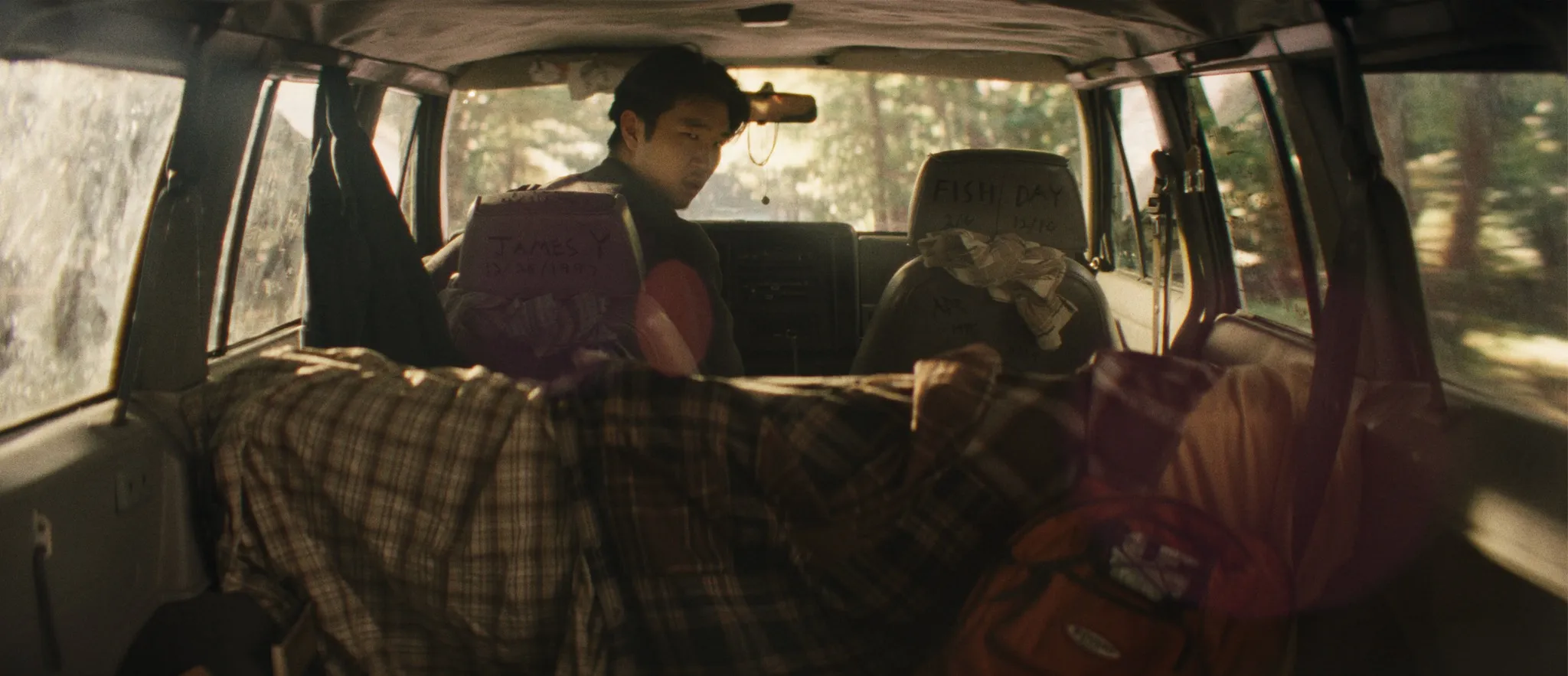
After college graduation, four friends — James (Phinehas Yoon, Smoking Tigers), Tyler (Mitchell Cole, Against The Spread), Day (Akira Jackson, Chasing Raine, Urban Flesh Eaters) and Fisher (Noah Toth, Hollow Bedrooms, Senior Prank) — set out for a late-night drive before their lives take separate paths. After missing their turn, they discover the unfamiliar two-lane road has no exit, stretching endlessly through a dark forest. As they continue driving, they learn that if they stop, they are attacked by desperate strangers running out of the woods within 90 seconds. It soon becomes clear that they are on a road that operates by its own supernatural rules and that they only have one option: keep driving. No longer bound by the limitations of hunger, sleep or the need for fuel or power, the friends are forced to confront their fears, fractured relationships and the possibility that they may be on this road forever.
It Ends sucked me in quickly with a wild yet irresistibly frightening premise, but its metaphysical subtext is what ultimately makes the film so satisfying. Beneath its apocalyptic road-trip premise is a surprisingly thoughtful meditation on mortality, faith and the human need to believe that our lives are leading somewhere. It Ends brings to mind movies ranging from Ingmar Bergman’s The Seventh Seal (1957) to Ang Lee’s Life of Pi (2012) in the way it uses a fantastical journey as a metaphor for the journey of life itself and for the question of whether a divine purpose exists at the end of the road — or whether we’re simply driving toward nothing. Layers of symbolism abound, and an uneaten peanut butter Cliff Bar takes off on profound existential significance. What makes the film especially compelling is that it doesn’t necessarily insist on either answer. Instead, it leaves room for both the person who needs to believe there is a destination and the person who can accept that there may not be one, suggesting that perhaps the act of continuing down the road is more important than knowing where it leads.
The road becomes a kind of existential limbo, with each mile bringing them closer to an ending they cannot understand or control. For some, the only way to keep moving is to believe that there must be a reason for the journey, even if there is no evidence to support that belief. For others, accepting that there may be no grand design is not the same as giving up. It can mean simply choosing to keep going because life is happening now, rather than because some ultimate destination awaits. In that sense, It Ends finds something surprisingly hopeful in its bleakness: Perhaps meaning isn’t something we’re given at the end of the road but something we create while we’re traveling.
The four largely unknown leads do very solid work, each taking characters who could easily have come across as obnoxious, self-centered or difficult to root for and gradually revealing the humanity beneath those rough edges. Rather than reducing them to archetypes, the performances give each character distinct vulnerabilities, fears and motivations, making their choices feel believable even when they’re frustrating. Yoon and Toth, in particular, bring surprising depth to their roles, finding moments of vulnerability that make both characters considerably more compelling than their initial impressions suggest.
It Ends doesn’t have the highest jump scare or shock value ratio of a horror film this year by a long shot. It relies on creating fear and drama by looking into the central questions of who, why and where we are, where we’re going and the reality that none of us can definitively answer them. It’s a surprisingly sophisticated film that will get stuck in your head and a refreshingly skillful and thought-provoking entry into a genre that far too often follows the same old roadmap. —Patrick Gibbs
Read more film reviews by Patrick Gibbs:
Film Review: The Magic Faraway Tree
Film Review: Teenage Sex and Death at Camp Miasma
Enjoying SLUG’s coverage of films? Consider joining our community of donors!
