How Mu Zhengyang Made All Wishes Come True!
Film
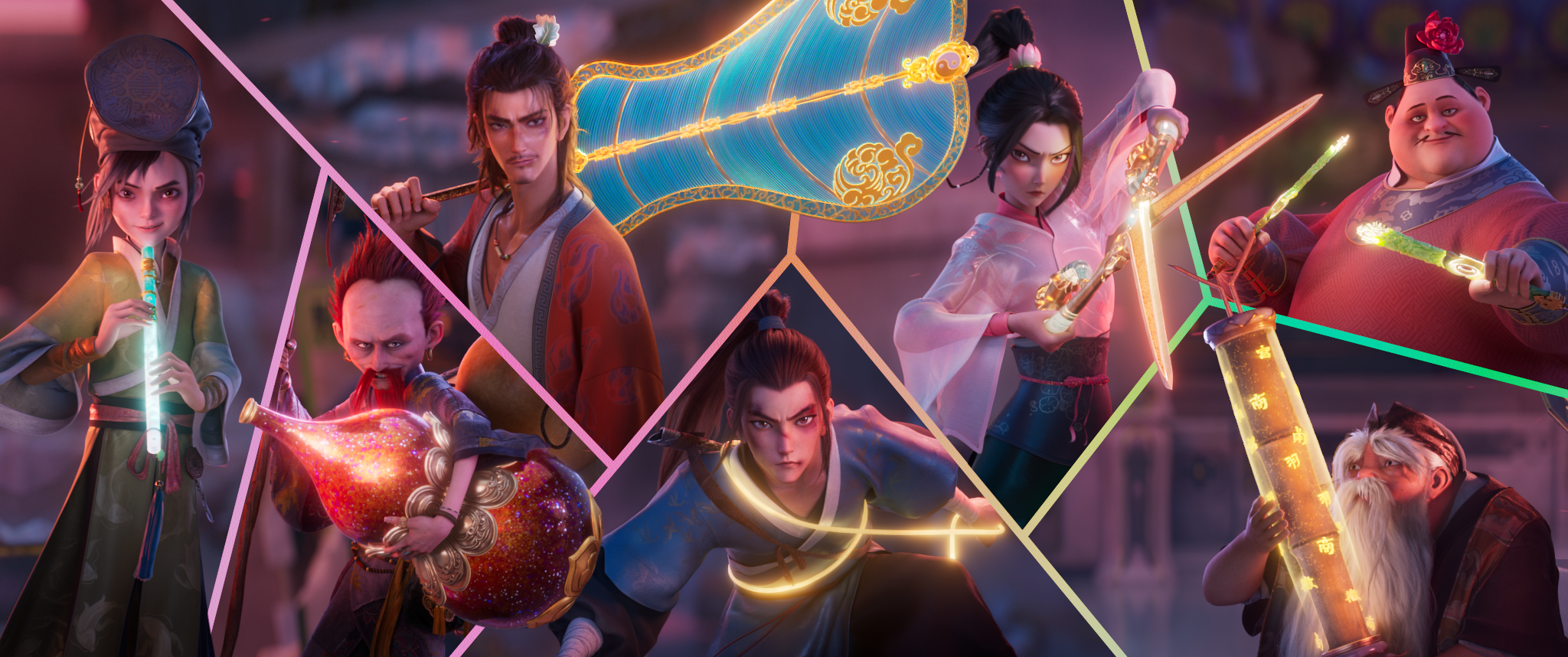
Chinese mythology gets a playful new interpretation in All Wishes Come True!, a groundbreaking new animated feature from Pearl Studio, the filmmaking powerhouse that was formed as part of DreamWorks and is now producing its own film and television productions in China and around the world. The ancient Chinese legend of the Eight Immortals has been reimagined for a contemporary audience in a visually breathtaking film that’s part caper comedy, part epic adventure and part fable. Written and directed by Mu Zhengyang, the film takes characters who are well known to Chinese audiences and gives them new personalities, relationships and challenges while preserving the cultural ideas at the heart of their mythology.
“The story of the Eight Immortals is very familiar in China,” Mu explains. “Although they’re very famous, and ordinary Chinese people all know their names, the actual stories of the Eight Immortals are somewhat vague to many people.” All Wishes Come True! begins on the magical island of Penglai, where mortals and Immortals live side by side. Lü Dongbin (Li Shaozhe) and Zhongli Quan (Hao Chen, Ne Zha, The Storm), a swordsman and a thief brought together by circumstance, hatch an audacious plan to infiltrate a legendary vault said to contain unimaginable treasures, including the powerful Yu-Xu Lantern. Posing as Immortals, they recruit six unlikely companions to pull off an impossible heist. But their quest soon uncovers an ancient conspiracy that threatens the fragile balance between the mortal and immortal worlds. “What we actually wanted to do was reinterpret the story in a new way,” Mu says. “What we wanted to preserve was the most important spiritual core of the Eight Immortals as an IP and as part of traditional Chinese culture.”
Mu studied Digital Media at the School of Design at China’s Central Academy of Fine Arts, where he created student and short animations including One Small, One Big (2015) and Black and White and Stripes, the latter earning recognition at the 2015 Golden Hitching Post Award College Student Video Art Festival. All Wishes Come True! marks an impressive feature debut, and for the young filmmaker, one of the most appealing aspects of the mythology was the humanity of its legendary figures. “They represent ordinary people,” Mu says. “They’re flesh-and-blood characters with flaws.” 
That humanity became central to the film’s interpretation of what it means to be an immortal. Traditional Chinese mythology associates immortals with supernatural abilities such as flight, invulnerability and extraordinary longevity. Mu wanted to look beyond those familiar characteristics. “The most important concept in All Wishes Come True! is the idea of becoming an immortal,’” Mu says. “In Chinese culture, that concept has many different meanings and descriptions… We are ordinary people. We have shortcomings and imperfections. We are flesh and blood, and we will eventually die. We don’t necessarily possess magical powers or supernatural abilities. But if we do the right thing, if we are kind and if we care about all living beings, then we can still be called immortals. That is one of the film’s most important central ideas.”
The character of Zhongli Quan became a central point for the story, and for Mu, the chance to reinvent the character was an exciting opportunity. “Zhongli Quan was the character our entire team spent the most time and effort developing when we were creating the Eight Immortals,” Mu explains. One of the most well-known characters in Daoist folklore, he is usually portrayed as a stout old man with a long beard and a pot belly. “His entire personality and image were significantly reimagined.” The filmmakers ultimately made Zhongli Quan into more of a handsome rogue with a heart of gold leading man type, whose gruff, blustery exterior hides painful secrets about his past.
Because the Eight Immortals have such distinct personalities, Mu and his team wanted their individuality to be visible not just through dialogue or design, but through the smallest physical details. “One thing that was particularly important was making the characters feel real,” Mu says. “Because the characters are very different from one another, their appearances need to feel believable. We had to pay close attention to their body language, facial expressions and reactions.” That required the animators to approach each character according to his or her personality, carefully capturing subtle movements and expressions. Mu says those details were essential to making the fantastical characters feel grounded. “We wanted to retain a great deal of detail in the characters’ movements and expressions so that their reactions would feel genuine,” Mu says. “That was important to making the characters feel lively and believable.”
For Mu, the ultimate goal was to take figures deeply rooted in Chinese culture and make them accessible without stripping away what makes them meaningful. “We’ve created eight playful, enjoyable characters who can appear on screen and be seen and loved by audiences around the world,” Mu says. “For me, that’s extremely exciting.” In Mu’s vision, becoming an immortal isn’t about having supernatural powers. It’s about how we treat one another — and that’s a wish audiences everywhere can understand.
See more film interviews from Patrick Gibbs below:
Want to help SLUG continue covering new films? Consider becoming one of our donors!
