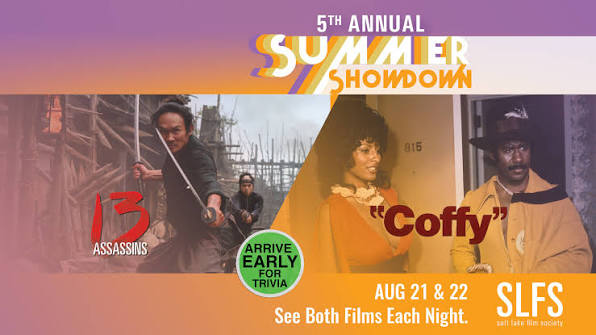
SLFS Summer Showdown: Coffy vs 13 Assassins
Arts
This week at the Salt Lake Film Society’s Summer Showdown, we had two action-packed spectacles facing off. One was a classic blaxploitation film that became a pillar of the genre and cemented the actress’ legacy. The other was a remake of a classic samurai movie. While very different at first glance, audiences can begin to see why these two films were paired with each other. However, the similarity lies in the fact that both films encapsulate the essence of their respective genres. Coffy defines the blaxploitation subgenre, and 13 Assassins harkens back to older chambara films.
Coffy follows Flower Child Coffin, a.k.a Coffy (Pam Grier), a vengeful nurse who uses her beauty to pose as a prostitute and lure mob bosses and drug pushers to her. She seeks revenge on the people who caused her younger sister’s heroin addiction and have destroyed her community. After her close friend Carter (William Elliot) is attacked by the mob, Coffy is further incensed and vows to find all the people responsible and exact justice.
13 Assassins is about a group of samurai who band together to assassinate the sadistic Lord Matsudaira Naritsugu (Goro Inagaki). Due to Naritsugu’s cruel and torturous behavior towards peasants and other clans, the Shogun’s advisor, Doi Toshitsura (Mikijiro Hira), enlists the services of Shimada Shinzaemon (Koji Yakusho), a decorated samurai, to put an end to Naritsugu to keep him from taking over the shogunate and causing war among the clans. Shinzaemon gathers skilled swordsmen of all backgrounds and plots their assassination.
Both films have rather simple storylines, one a quest for revenge, the other an assassination narrative. However, Coffy is more straightforward and to the point. The pace is faster and makes the plot feel like you are driving down the highway at 100 miles per hour — filling you with a penchant for danger. 13 Assassins, on the other hand, is a more complex web as it weaves in multiple characters, along with political intrigue. The narrative moves slower, but it gives the storytelling a poetic quality that builds slowly and blows you away with the explosive third act.
I also find the use of music in both films interesting to compare. Coffy has a groovy, soulful jazz soundtrack that speaks to the time and the culture it was made in. The music laces about every scene in the film, whereas 13 Assassins uses minimal music only in pivotal moments and opts to instead remain in the silence or highlight the natural sounds. The use of sound firmly establishes both of these films’ identities.
For Coffy, there are many qualities I admire. The griminess and graininess of the cinematography is a definite treat for a lover of ‘70s cinema. Coffy herself is a fascinating and exciting character to follow. Grier imbues the character with a sense of strength and purpose that keeps you engaged and anticipating her next move. Coffy is someone who uses her sexuality to her advantage and exploits the stupidity and, dare I say, naivete of the men around her to get closer to her goal. Still, her Jamaican accent was abhorrent and inconsistent. I also admire this film’s ability to address political issues. It is no wonder that this character became such a notable archetype in blaxploitation cinema. However, it is its nature as an exploitation film that keeps me from completely loving it. One of the main critiques of blaxploitation is how it reinforces certain stereotypes about the Black community. It also features scenes of attempted assaults and one scene of a man being dragged violently by a car that particularly disturbed me.
What I loved about 13 Assassins was the beautiful use of composition. Takashi Miike’s eye creates beautiful imagery that sticks with you even when the subject matter itself is upsetting. One moment in particular is when a young, limbless woman holds up a scripture spelling out what Naritsugu did to her family. All the actors are clearly giving it their all, and most manage to make their characters feel distinct despite the limited screentime, which leads to my main critique: there are too many characters. Not even counting the titular assassins, Shinzaemon, the advisor, Naritsugu and his retainers, along with civilians caught up in the rising tension, can leave the film feeling overstuffed. This, however, stops being an issue by the end once the assassins have gathered and become the main focus, but this doesn’t happen until an hour into the movie. There is also some rather dated CGI, even for the standards of 2010, that does take you out of the movie at times.
Out of all the Summer Showdowns, this was the hardest to choose between. Both films are action-oriented but have different goals for what they want to say and explore. I also find rewatchability to be a metric I can’t rely on, because my desire to rewatch either one is equal. But it is a Summer Showdown, and since there can only be one winner, I guess I would have to pick 13 Assassins simply because I believe it is the kind of movie that is more rewarding during a rewatch. —Angela Garcia
Read more reviews from Angela Garcia below:
Series Review: Avatar Aang: The Last Airbender
Goldmyth, Little Moon and The Aces @ Provo Rooftop 08.21.2026
If you enjoy SLUG‘s coverage of local film events then consider joining our community of donors!
