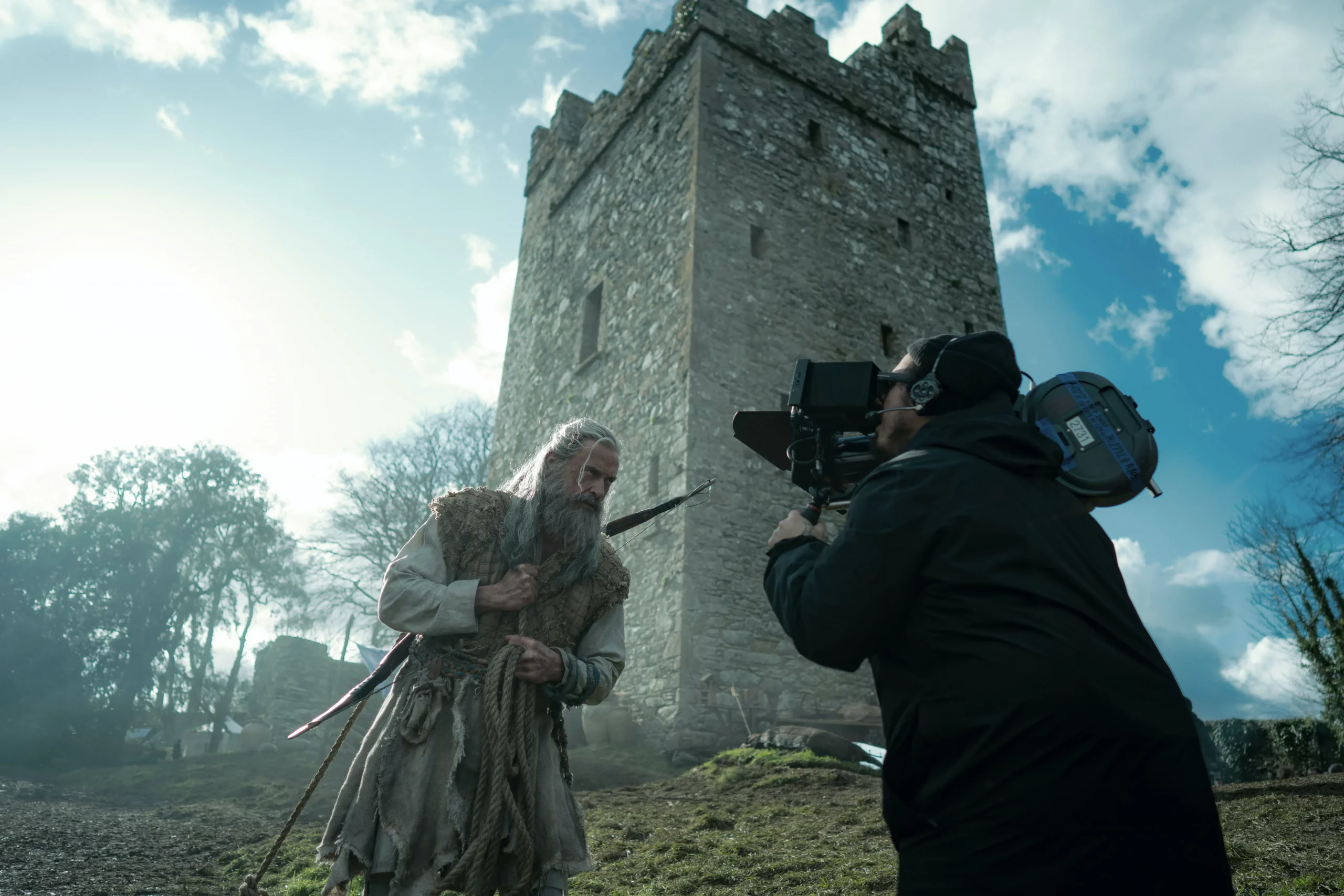
Pat Scola Hits A Bullseye with The Death of Robin Hood
Arts
The art of cinematography really comes down to balancing darkness with light, and for Pat Scola (ASC), that balance hasn’t just been part of the craft, it’s been a recurring theme in the stories he’s bringing to the screen. With films like Pig (2021), Sing Sing (2023), A Quiet Place: Day One (2024) and his latest effort, The Death of Robin Hood, Scola returns to his fruitful collaboration with writer-director Michael Sarnoski for a bold take on one of fiction’s most enduring legends.
“I’ve worked with hundreds of directors in my career, especially because I work in so much short form,” Scola says. “And it’s not really often that you find a relationship with someone that you see the world so differently, but so similarly, in terms of how to make a film and what it should be.” That collaboration, which began on the acclaimed 2021 drama Pig, starring Nicolas Cage, has evolved through years of creative trust and productive conflict. “I would say that we find an agreement, like 90% of the time,” Scola explains. “And then the 10% of the time when we disagree, it’s not a subtle disagreement, it’s like war. But in a lot of times that war brings about choices that neither one of us would have come to on our own.” That process became even more open on The Death of Robin Hood, a project that demanded a carefully crafted visual language to support its emotional and psychological journey. The story follows an aging Robin Hood (Hugh Jackman, X-Men, The Greatest Showman) who lives as a fugitive, haunted by the life of violent crime that became an altogether fabricated legend. When Robin is gravely wounded, he finds refuge in a secluded priory run by the kindly Sister Brigid (Jodie Comer, Free Guy, The Bikeriders).
Scola describes an intensive preparation process in which he and Sarnoski examine every line of the screenplay. “When we prep a film, we sit in a room and go through every word of the script,” Scola says. “Sometimes it inspires script changes. As we’re creating the visual language for the film, things will change in the script because of that.” Central to that visual strategy was an ambitious approach to format and lensing. The film was photographed on 3-perf 35mm film, and it undergoes a significant aspect-ratio shift a third of the way into the film. For the opening section, Scola employed Panavision Ultra Panatar II lenses, becoming the first production to pair the lenses with a 3-perf 35mm camera system to achieve a 2.39:1 widescreen image. “We knew that we wanted to change aspect ratios in the film when we went to see the priory,” Scola explains. “We knew from a strictly aesthetic standpoint, we’re inside of a room for the next 50% of the movie,” Scola says. And we wanted the ability to kind of not feel claustrophobic and choked by a 2:39 widescreen matte. We wanted to just feel a little higher in this place.”
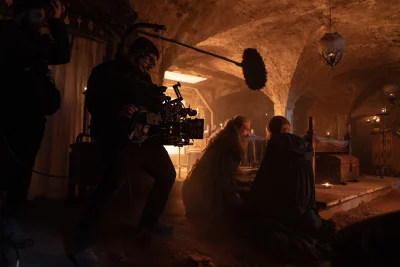
The decision was motivated by both aesthetics and storytelling. As Robin’s journey leads him to the priory, the filmmakers wanted the visual presentation to evolve alongside the character’s experience. “That transition also reflects Robin’s internal transformation,” Scola explains. Once the story moves into the priory, Scola abandoned the anamorphic lenses in favor of Panavision Primo spherical lenses, allowing the camera to engage more intimately with the actors.
“We really wanted to be able to lens the face closely enough and fully enough that you could really access the actors,” Scola says. “A lot of the shooting in the film, you’ll notice, it’s a little bit more classical. And on the eyeline, we’re very close to the actors’ eyes often.”
Scola notes that contemporary cinematography often favors compositions that drift away from direct eyelines for stylistic reasons, but The Death of Robin Hood required a more immediate emotional connection. “We found it necessary to just kind of exist inside their faces,” Scola says.
The transition between formats is itself a key storytelling device. As Robin is wounded and transported to the priory, the film enters a subjective, dreamlike state intended to place audiences inside his fractured consciousness. Rather than relying on familiar visual clichés, Scola sought a more distinctive approach. “We really wanted that to feel like its own thing, something unique,” Scola says. In order to achieve that effect, Scola turned to a Lensbaby, an unconventional optical tool more commonly associated with experimental photography than major narrative features. “It’s basically a lens made of plastic,” Scola explains. “When we tested this on 35 — and I’ve used this on digital before, with mixed results — the renderings of that lens were just spectacular.”
The visual design of The Death of Robin Hood mirrors its emotional and spiritual themes in inspired and creative new ways, thanks to the work of filmmakers who aren’t afraid to defy convention. Through shifting aspect ratios, carefully chosen lenses and a deeply collaborative creative process, Scola and Sarnoski continue the partnership that began with Pig, crafting imagery designed not merely to tell a story but to immerse audiences in the experience. The result is a well aimed shot that lands right on target. – Patrick Gibbs
Read more film reviews and interviews by Patrick Gibbs:
Film Review: The Death of Robin Hood
Film Review: Toy Story 5
To help SLUG continue covering upcoming films, consider becoming one of our donors!
