Phil Arntz Takes Aerial Cinematography to New Heights
Arts
Phil Arntz has built a career capturing images that most of us only dream of seeing. From the frozen cliffs of Norway in Apex to the urban tension of Fuze, Arntz has become one of the industry’s go-to aerial cinematographers, lensing large-scale action from helicopters and aircraft, bringing audiences into the middle of impossible stunts, vertigo-inducing landscapes, and high-speed chaos.
“I used to love watching movies when I was really young and l got really interested in how they would make all these things,” Arntz says. That fascination quickly evolved into experimentation with cameras at a young age before growing into a professional career. “I was filming a lot of extreme sports projects, where that’s like motocross or skydiving or wingsuit flying and all of that,” Arntz says. “And we were like, ‘how do you keep up with these incredibly quick athletes?’ And helicopters were sort of one of the ways to do that.” That pursuit of movement and scale naturally translated into narrative filmmaking, where Arntz is called in for productions requiring technically demanding aerial work. For the London-set heist thriller Fuze, which stars Aaron Taylor-Johnson and Gugu Mbatha-Raw, Arntz and his team were tasked with giving the film a sense of geography and urgency. “You’ve got this high stakes film, set in the middle of London, and how do you give it a sense of scale?” Arntz says. One of the production’s most difficult tasks involved an elaborate opening shot that required helicopter photography to seamlessly blend with drone footage. “We did a big one-shot opening,” Arntz says. “That was technically quite challenging in terms of finding the right routes to fly, finding the pacing for that, and then also marrying that up with stuff shot on a drone.”
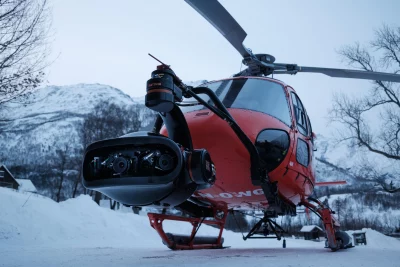
While Fuze emphasized urban logistics, Apex required Arntz to confront some of the harshest natural environments imaginable. The opening climbing sequence for the film took Arntz to Norway, where characters portrayed by Charlize Theron and Eric Bana scale the Troll Wall, one of Europe’s tallest vertical rock faces. The sequence depended heavily on aerial footage to establish the danger of the environment. The crew spent roughly a week in Norway in brutal winter conditions shooting from helicopters equipped with Sony Venice cameras and Fujinon Premista wide zoom lenses. “It was freezing cold, but it looked incredible,” Arntz says. The Venice proved especially valuable for aerial work because of its built-in ND filters and extended recording capabilities. “The Venice has gone a long way to make things easier and better for us,” Arntz says.
The production also required intricate collaboration between cinematography and visual effects teams. Because much of the sequence later involved volume work and green screen integration, Arntz’s team had to capture extensive environmental material from the air. “Once you’ve shot this sequence in about a week’s time, you’re then really supplying all those assets,” Arntz says. “You’re not going back to Norway to pick up certain things that were missed.” The biggest challenge wasn’t simply obtaining dramatic footage, but doing so safely while pushing the limits of what helicopters could achieve. “You’re basically trying to push a helicopter as close as possible to the wall without putting anyone in danger with rock falls and all of that,” Arntz says.
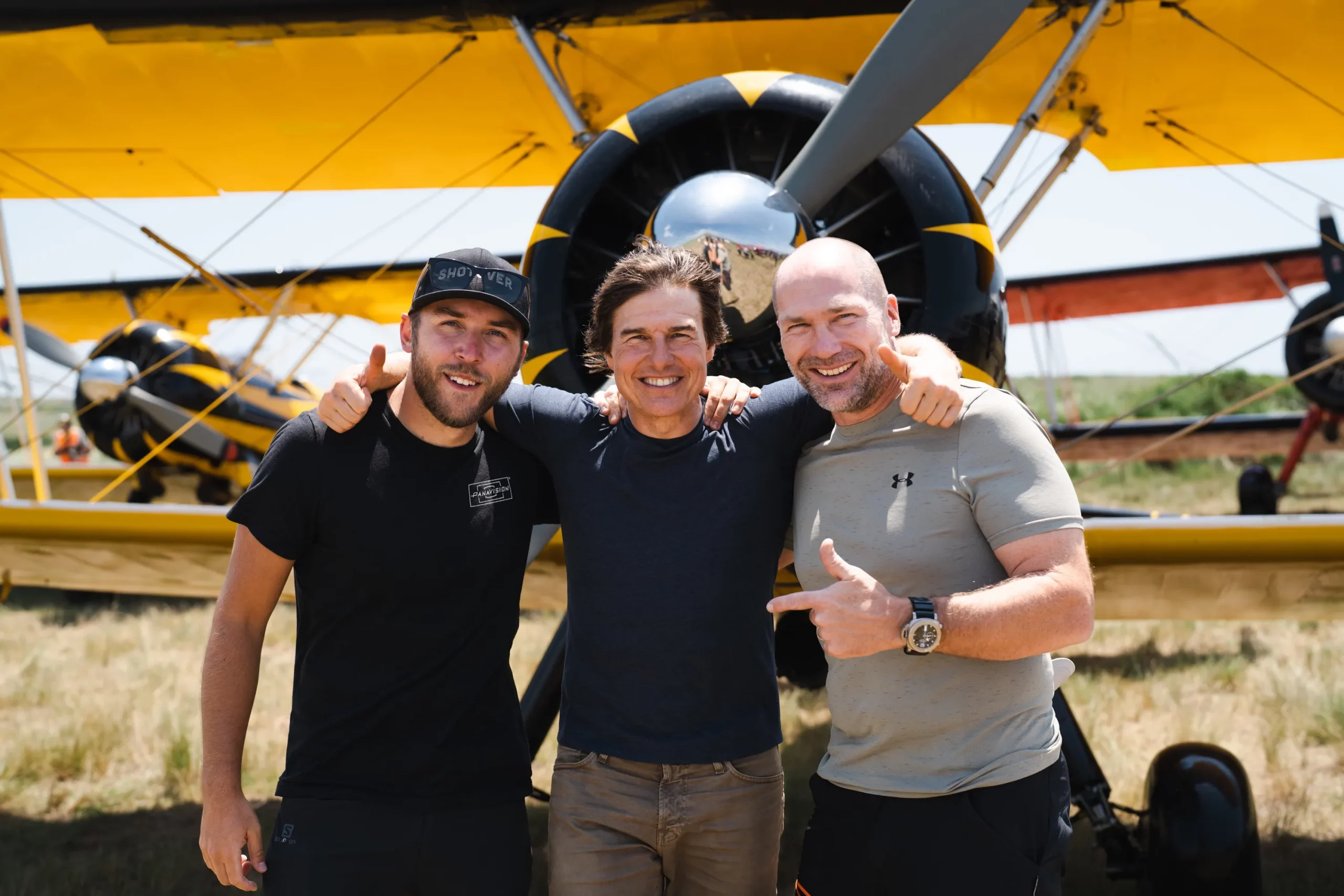
That balance between spectacle and precision has also defined Arntz’s work on the Mission: Impossible films, which have pushed practical aerial filmmaking into new territory. Arntz first worked with Tom Cruise and director Christopher McQuarrie on the motorcycle cliff jump sequence in Mission: Impossible – Dead Reckoning. “We landed it on the first take,” Arntz says proudly. That success led directly into extensive development work for the next film’s ambitious biplane sequence. “No one’s ever really shot anything like that,” Arntz explains. “We basically went out to try and figure out and establish: how do we shoot this in an efficient way?” The process involved months of experimentation and problem-solving. The team had to locate the right pilots, maintain vintage aircraft flying up to ten hours a day, and determine what kinds of maneuvers Cruise could safely perform on a biplane while cameras operated nearby. “You establish elements, you prove elements, then you add something else,” Arntz says. The solution was a combination of helicopters, mounted aircraft cameras, and formation aerobatics. “He’s on a plane on the wing, and the plane is pulling in the foreground, and I’m sitting there basically shooting back at him,” Arntz recalls. The key to successful aerial cinematography isn’t simply technical expertise. Arntz stresses the importance of understanding how aerial photography fits into the broader visual aesthetic of a film.“You have to have these in-depth conversations with the DOP and find out what the visual language is, and then basically translate that into the air,” Arntz explains. “What you don’t want to happen is that you start shooting all of these aerials, and when it goes into the edit, it jars with the groundwork.”
Whether capturing climbers thousands of feet above Norway, navigating helicopters through London, or flying alongside Cruise, Arntz approaches each project with the same philosophy that inspired him as a child: taking audiences somewhere they’ve never been before.
Read more film interviews conducted by Patrick Gibbs:
Bill Dubuque and Karen Campbell on Finding The Story Behind M.I.A.
Renny Harlin Brings His Signature Brand of Bite to Deep Water
