SLUG Style: EJ Porter
Arts
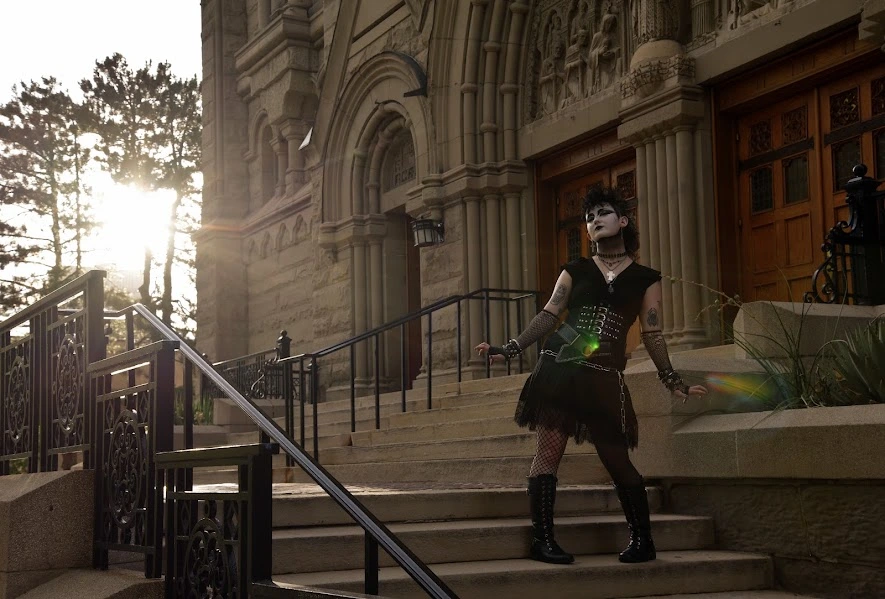
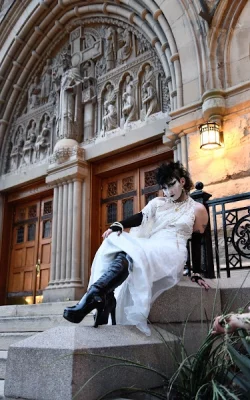
EJ Porter (they/she) is a beginner drag artist, musician and lover of all things dark and dramatic. With a love for DIY and thrifting, she turns trash into treasure, picking things up off the ground or from the rack and turning it into a rebellious look. The goth subculture allows them to step outside with confidence, finally feeling comfortable in their own skin.
Every month, SLUG Style features a distinct member of the community and asks them why they do what they do. Exploring more than just clothing, SLUG Style is an attempt to feature the people who give Salt Lake City flavor through personality and panache.
What are your stylistic influences? This could be a band, decade, fictional character — anything.
Goth, like most alternative subcultures, is motivated by music. It’s a culture that prides itself on diversity. No two bands are alike — from darkwave, moody synth to 80s rock, each era and artist has its own distinct sound. An individual’s music taste often dictates their personal style.
For example, I adore X-Ray Spex, Siouxsie and the Banshees, Scary Bitches, Academy Order and She Wants Revenge. I love to listen to the music and pick apart the way it makes me feel. Most songs make me feel powerful and rebellious. A lot of goth music boils down to dark, tragic love songs, and I like those as well.
Goth also derives inspiration from Victorian and Edwardian mourning culture. Mourners, especially female mourners, would wear thick, black clothing with long veils and shut themselves indoors for months at a time. Classic literature from this time period also influences modern goth a great deal. Mary Wollstonecraft Shelley (author of Frankenstein) is regarded in pop culture as the original “goth girl.” There’s nothing more goth than losing your virginity on your mother’s grave and keeping your dead husband’s preserved heart in a jar on your desk. From lead singers to long-dead writers, goth has a multitude of role models to choose from!
What does the goth subculture represent to you? How did you find this community?
Goth is disruptive. It’s obscene. You can’t look away.
I found goth through punk. As an outcast teenager, the loud, grungy, rebellious subculture drew me in. My battle jacket became a suit of armor, my spiked boots my weapons. It became easy to stalk the streets alone at night — people in the nicer parts of town would literally rather cross the street than walk toward me on the sidewalk.
In the right circles, however, my battle jacket got its share of compliments — but nothing compared to seeing the stares, the whispers, the confused double-takes of polite society. Strangers on the street were reading the patches on my jacket and all of a sudden knew what I stood for. They *saw* me.
All of a sudden, I became a beacon of resistance. My battle jacket, smeared with slogans like “GAY LIB NOW,” “ACAB,” “DEATH TO FASCISM” and “DO NOT PET,” made it clear that I wasn’t about to take shit from anyone. I marched in protests, went to demonstrations and chanted “Power to the People” with the best of them.
Punk is derived from poverty, from rebellion against all the systems that keep us under their thumb. Consumerism, capitalism, the gender binary — you name it, we hate it. The music is loud and unpolished, designed to be a vessel for pure, righteous anger. Punk fashion is centered around recycling, repairing and refurbishing clothing — what started as a necessity for indigent people became a fashion statement.
However, that was one of the things that irked me. Every time I put on my battle jacket, I felt this itch — and no, not because it was dirty. Something inside me was fundamentally upset at wearing the exact same thing every day… The same jacket, the same boots, the same crust pants.
Obviously, there’s nothing wrong with that; but my creative soul was desperate not to be an outfit repeater. I had to come up with something new. Something eye-catching. Something… dramatic.
I often say that goth and punk are brother and sister, and that much is true – they both evolved from similar movements during the same time periods in the same place. However, where punk is angry and active, goth is more despondent and melodramatic. The style seamlessly blends rebellion and spectacle with romance and the macabre.
I was captivated by everything goth — from the striking silhouettes of magazine models to the sexual degeneracy of everyday deviants. I adored the tragic, soft romantic outfits as much as the loud, obscene ones. There was a duality in goth that I hadn’t really seen in punk, and I wanted to know more.
I experimented with monochrome drag makeup. A white base over glued-down eyebrows made for lots of striking looks. I drew on mustaches, beauty marks and bought various 1920s-inspired wigs and clothing pieces. However, it’s notoriously difficult to start a drag career as a minor. Most queer spaces, especially in Utah, are open exclusively to a 21+ audience.
It wasn’t all bad, though. I enjoyed the ritualistic feeling of layering the white foundation, trying out new eyeliners and lipsticks and trawling Pinterest boards for new looks. I especially adored how the thick makeup covered my red, blotchy cheeks, which are by all accounts my greatest insecurity. PMOS (polyendocrine metabolic ovarian syndrome) has taken a lot from me, but I’ll never forgive it for scarring my face with painful cystic acne. However, my white face paint covers it easily.
Anytime I step out in goth, I feel like Cinderella at the ball. Suddenly, I’m beautiful, desirable and something to be feared. Confidence comes easily when my face is disguised under huge winged eyeliner. At goth events, I’m drowning in compliments on my hair, makeup, whatever outfit I’m wearing. I’m suddenly awash with stimulating conversation on anything from band controversy to which thrift store has the best deals. The goth community means everything to me. The style is a loud and clear beacon to all other weirdos: “I’m cool! Come be my friend!
What are your interests or hobbies? What is the hobby or interest that you have that no one would realize to ask you about?
The time I spent at protests gave me a huge appreciation for folk music and its historic use in organizing movements of change. From the union men of the industrial revolution to the anti-war movements of the mid 20th century, music has always been a part of it.
Not long ago, I picked up the guitar and enthusiastically began to learn all the John Prine and Joan Baez I could. I’ve always had an okay singing voice and a good ear for music. Folk music is unique in the way that it’s simple and easy to learn. That’s how songs spread from artist to artist, from person to person, from heart to heart.
However, I realize that the girl with a deathhawk, hip chains and huge false lashes might not look like the kind of person to pick up her acoustic guitar and serenade you with old union songs. In a way, my guitar playing is sort of just for me.
I’ve written some of my own tunes as well, and through my connections to Weber State University, I’ve had the honor of being the guinea pig for the audio recording students. My voice should soon be on a few streaming platforms in about a year or so.
What are some of your favorite community events to attend? Why is it important to have designated spaces for each subculture?
Since early 2025, a monthly downtown Salt Lake goth night has been my happy place. Love Like Blood, hosted by the Beehive at Mark of the Beastro, was the pinnacle of good music and even better fashion. Other goth nights are alright, but no one does it like those kids at the Beehive. I really think goth is coming back in a big way, especially with people from the younger generations.
The Beehive hosted all kinds of events — from nude model drawing sessions to slam poetry to battle of the bands, it was an amazing community center for all the freaks and weirdos. Of course, past tense in this context is used with a heavy heart. The historic building at 666 S State Street recently closed in early July 2026.
Rent hikes due to increasing repair costs have forced the owners to shut down Mark of the Beastro and seriously consider demolition. Their tenants have a strong theory that Intermountain Health’s struggle to take up residence in South Salt Lake is the likely culprit.
The city council is rightfully concerned about a new development’s impact on small businesses — a swath of fresh asphalt and new parking lots might kill the local vibe. From what I’ve heard, IHC’s plan has been to purchase all the local buildings and demolish them, killing two birds with one stone.
It’s unfortunate, but The Beehive is currently homeless. Its organizers are left treading water, waiting for a new place to call home. Personally, I hope they find one soon. As the beginning of August nears, I’m about to experience the first month in a long time without a goth event to attend.
Part of me doesn’t want to migrate somewhere new. 666 S State Street was perfect. The walls were covered in protest signs, posters and graffiti. Winter meant no heating, and summer meant no AC. The roof leaked onto the dance floor when it rained. The bathroom was quite literally haunted (RIP Sally). But it was home.
Are you always “on” or would someone see you at the grocery store, for example, with fewer elements of your style?
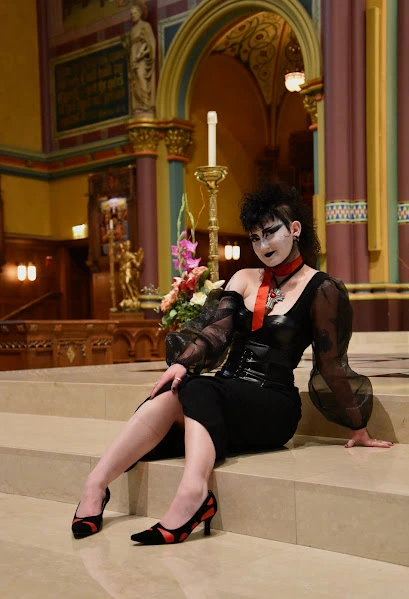
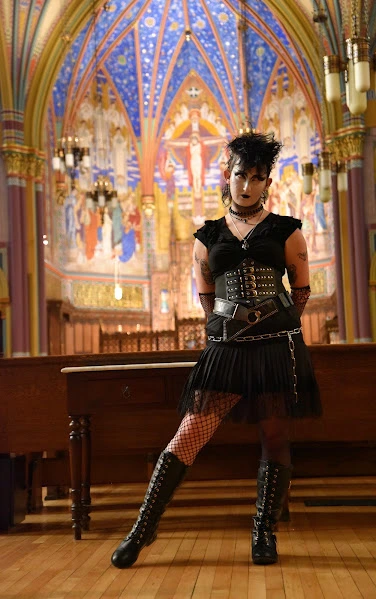
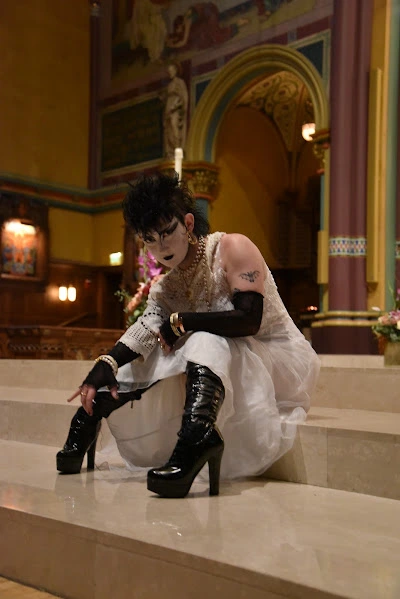
It’s shameful, but the summer heat has forced me to abandon my usual heavy polyester and long hemlines. I’ve found myself leaning toward short-sleeved blouses and ripped jean shorts. Even though I can’t dress in traditional goth every day, I always try to incorporate elements of the style into everyday wear.
In casual day-to-day clothing, I still enjoy putting outfits together. All of my clothes are black — my closet and dressers are deep voids of darkness. I’ve been getting into the emo and scene styles lately, and I never leave the house without black smoky eyeliner.
When it’s not a normal day, I take every opportunity to dress up, and I mean that literally. I’ve been tentatively banned from family events like weddings and religious ceremonies because they know how I dress. Even with a toned-down look, I still upset conservative norms.
Tell me about the process of putting together your looks. Where do you find your pieces?
Every few months, I get the itch to go shopping again. I hit up the thrift stores on Hill Field Road in Layton, especially the Savers. I find jewelry at retail stores like Hot Topic or Spencer’s — even Spirit Halloween when it’s in season. Treasured Again in Layton is a fantastic antique mall with an incredible jewelry selection — I can always find something unique there.
When I go shopping for clothes, I have to take into consideration that several thrift stores have closed their fitting rooms to stave off shoplifters. I wear a go-see outfit (just a tank top and leggings with a short heel), and I try on everything I can in the aisle, determining if something is going to fit before I buy it. Even if something doesn’t fit at all, I alter most of my clothes anyway — chopping off sleeves, cropping midsections, lowering hemlines.
DIY is the lifeblood of goth. If something doesn’t fit, make it fit. If a pendant would look good on a different chain, go shopping for a new chain. Want spikes on a bra? Poke those holes yourself, girl.
If you had to describe yourself in three words, what would those be?
Permissive, impulsive and insecure.
My personality is a cocktail of contradictions. I’ve always been described as a people pleaser — external validation is what drives most of my decisions. Especially as a child, I was taught not to have boundaries or personal aspirations. I did whatever I was told. I think in a way, the goth community fills that hole. I can do whatever I want, and I get massive compliments from it.
I tend to jump at opportunities whenever they come to me. As someone who rarely takes chances, I make sure that the ones I take are worth it. For example, this interview and photoshoot! Normally, I would never do something like this.
I’m also pretty self-conscious. I mentioned earlier that my goth makeup hides my face, and that’s what I like about it. An average goth transformation takes over two hours to complete. There are so many things about my appearance that I don’t like, and it takes a lot of effort for me to feel beautiful.
What are some recurring motifs in your personal style and life?
Irony follows me like a starving dog. I’ve heard it said that some of the funniest people are the ones with the saddest pasts, and I’ve found it to be true time and time again. Whether it’s family, dating or school, any topic of my life is dripping in sweet, sweet fuckery.
I love meeting new people, but context always comes around to bite me in the ass. Every time I find myself explaining something from my childhood or my teen years, the listener doesn’t know whether to cry or laugh. I guess that’s part of the spectacle, though, right? Why shouldn’t my life be a cruel joke? It’s just the cherry on top of a black-and-white cake.
Goth is all about contrast, after all. Black vs white, beauty vs ugliness, joy vs sadness. It’s all one big, dramatic mess, held together by safety pins and hairspray.
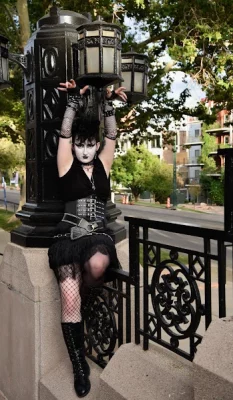
How has your personal style evolved over time?
As a child, my clothes were always chosen by my mom. She grew up poor, and so did my dad. We never went shopping for new clothes. They were always hand-me-downs or thrift store discounts — each of them a few sizes too big so I could grow into them. Any shoes had to be masculine so that I could pass them down to my brothers when I outgrew them.
My parents divorced right when I entered puberty. I went no contact with my mom when I was fourteen. She had never taken me bra shopping, never taught me how to use makeup, never offered any kind of tips on style.
So, I dressed terribly. I told myself I didn’t care how I looked, that if someone really liked me, they wouldn’t care about how nice my clothes were. I prioritized comfort and modesty above all else. I wanted to be unseen, unnoticed. In my mind, everyone was staring at me, judging me, looking at me with rightful disgust. Fashion wasn’t for a person like me. I didn’t deserve it.
Eventually, something in me snapped. My creative spirit refused to be stifled under piles of baggy secondhand hoodies. I don’t remember if it was a gradual decision, but I eventually just stopped caring what people thought. I wanted them to see me. To notice my pain. To see that I was real and worth helping.
Make no mistake. Goth is not a cry for help. It’s taking pride in who I am. It’s my way of saying: “Look what you’ve been ignoring. Look what you’ve been missing. This is who I am. This is how I feel. This is what I’ve done all on my own.”
If you could give a piece of advice to your younger self, what would it be?
If you’re scared they’re always watching, why not give them a show?
Read other SLUG Style features:
SLUG Style: Romy-Krystal Cutler
SLUG Style: James Newbold
To help SLUG continue its support of alternative subcultures, consider joining our community of donors!
