A Reckoning: Mountain People and the Great Salt Lake
Activism, Outreach and Education
As a Utah-born-and-raised girl, I remember the fits of teenagerhood in Salt Lake suburbia well. Many of you underground readers remember it too, I know. It wasn’t always smooth-sailing around here for the “artsy” ones, and the dog days of summer (which refuse to quit this year) remind me of that inevitable urge to get out. I remember inquiring my father about his travels as a young adult, daydreaming of what my own could be like. He’d traveled everywhere, as a slender ski bum and deadhead who followed the band through Europe and wherever-the-heck else; I don’t remember. The thing that stayed with me was the story he’d tell about coming back. It went something like: “You’d get off the plane, catch your ride out of the airport and hop on I-80; just beat tired. As you’d drive you’d see the tips of the sparkling Rockies kind of peek up in the horizon. And then you’d think ‘Woo baby, I’m home!’” If I’m remembering right, the glimmer of his beloved Rocky Mountains after months without them was enough to make the man shed a tear on an occasion or two.
It’s stories like this one of mine that Kirsten Johannah Allen says were the missing puzzle piece in climate crises efforts, when she co-founded Torrey House Press with her husband, Mark Bailey, in 2011. It quickly reached international distribution in 2012 and was converted into a nonprofit in 2015. To Allen, storytelling was a means of advocacy — she felt there were voices that weren’t being heard, particularly around issues in the West, but also in a more broad sense on our “relationships with the natural world.”
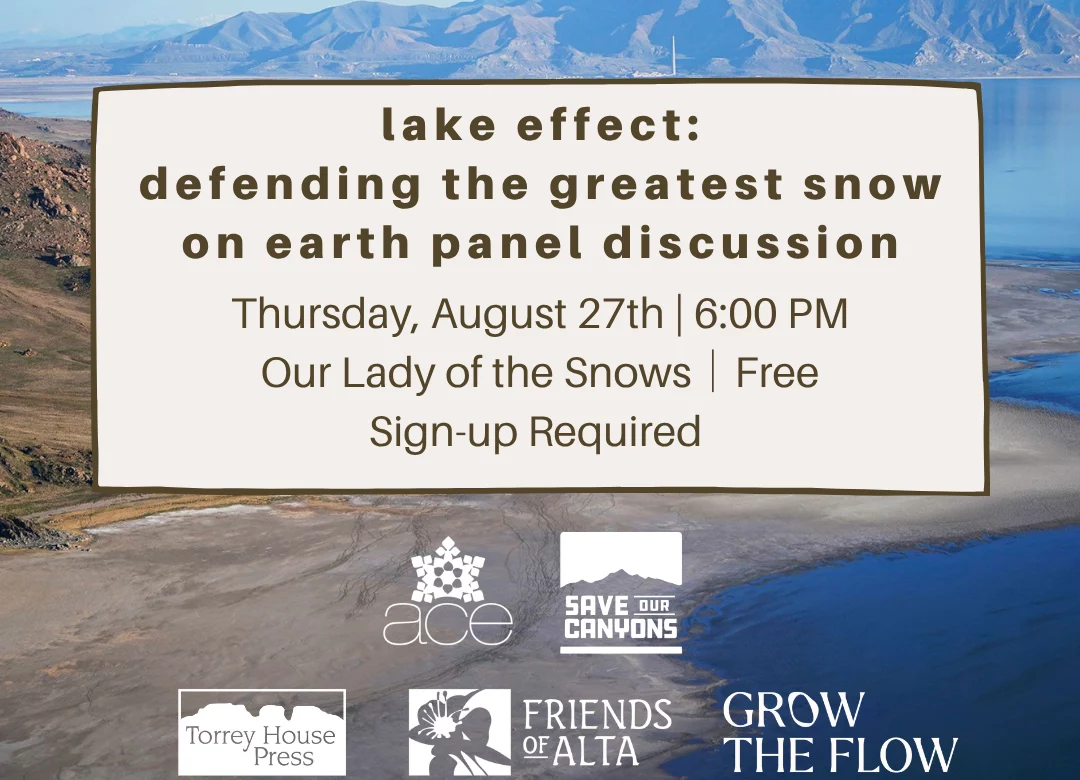
On Thursday, Allen is moderating a discussion panel called LAKE EFFECT, which she hopes brings stories of personal connection to the Great Salt Lake and Utah’s mountain ranges to the forefront. It’s the “hearts and minds” she’s after, she says.
As I spoke with her, Allen’s excitement peaked the moment she told me about a book, Shaped by Snow, written by panelist Ayja Bounous, a Utah-native skier and a “daughter of the mountains.” Bounous had generations of connection to the Wasatch Mountains, which dated back to the founding of some of the iconic ski resorts there. “And here she is watching the winters change and really feeling, ‘How does that change me? … What’s that like if we really are going to lose winter?”
View this post on Instagram
The impact of Bounous’ story made me think of my own memories chasing adrenaline at The Bird — my second home growing up. My parents were employees at the resort, and I spent my days in ski school, memorizing the mountain. Allen told me that just a hop, skip and a jump away from the bunny hill I grew up on would be the location for the LAKE EFFECT discussion. It was the perfect setting for such a conversation, said panelist and Grow the Flow managing director Jake Dreyfous, because “the headwaters of this watershed are really a place of reverence for many people in Utah.”
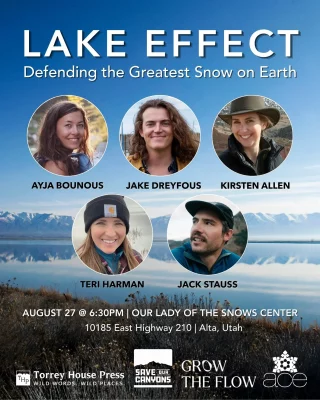
Dreyfous, also a mountain kid, grew up duck hunting and fishing at the Great Salt Lake, too. He said his wake up call didn’t come until, ironically, he found himself halfway across the country doing his undergrad in biology. He knew he’d come back. Now, he knew the jeopardy his home was in.
In 2026 alone, Utah has seen more frequent and more severe dust events coming from the lake bed. “We have a volunteer who lives right at the Antelope Island Causeway, and it feels like every week he’s sending me [footage] from basically his backyard of dust blowing into his community,” Dreyfous says. Those in Salt Lake might be far removed from the visuals, he says, “but that’s not to say we’re safe here,” with several recent storms reaching as far south as Utah County.
It’s why the LAKE EFFECT event is so important, because treating the water from the top of Utah’s peaks is “the spark of the hydrological system.” Even more than that, it’s a chance to help others understand their own connection with the land and the significance of their own power to fight collapse, as the mountain people they are.
LAKE EFFECT will also feature panelist Teri Harman – who, along with Bounous, contributed to the anthology series The Once and Future Lake: Stories for Great Salt Lake – and executive director of Save Our Canyons, Jack Stauss. The discussion will be held at Our Lady of the Snows in Alta at 6:30 p.m. on Thursday, Aug. 25.
Read more by Mary Culbertson:
Why 24Tix Could be Your Hero, Just For One Day
Local Review: Anyone Awake — Bushel and a Peck
If you enjoy SLUG’s coverage of local community events, consider joining our community of donors!
