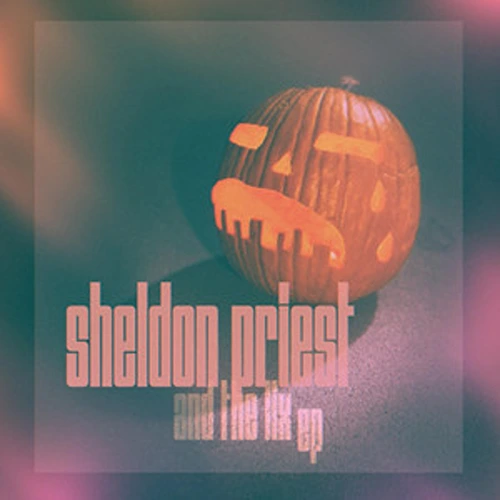
Local Review: Sheldon Priest — And The Lix
Local Music Reviews
Sheldon Priest
And The Lix
Self-Released
Street: 06.13.2025
Sheldon Priest = Pearl Jam + Alice in Chains
Picture this: it is the late ‘90s to the early 2000s. Flip phones are still in use, and Nokias are capable of chipping floors if you drop them hard enough. Somewhere, metalheads, rockers and even the occasional teenage dirtbag (as Wheatus once described) with a lot of hope and a fake ID are listening to a bar band. It’s a packed house, wall-to-wall with people who have spiked hair and studded jackets. The lights are low. The music’s loud. A security guard is lurking nearby but seems to be enjoying themself. It’s a grungy, dark space, far from being the Ritz or even Coachella by a long shot, but the place is alive. It’s rocking, and all that is left to do is sit back and enjoy it.
Alas, I cannot actually transport myself and others to the world of alt bands from the turn of the century, but when listening to Sheldon Priest’s album And The Lix, I was able to feel like for a moment. I could find myself in a place just like that, with confirmation of said authenticity coming straight from a bouncer I am acquainted with, who supervises gigs featuring this very type of music. With a sound similar to Good Charlotte and even at times, Radiohead, Sheldon Priest felt like a listening experience straight out of a punk’s local haunt. Fans of the older rock scene can rest assured that the spirit of their favorite genre is still alive and well today, and they can find it in And The Lix.
With an impressive range on the electric guitar, this album has a sound with a dynamic musical versatility, which, despite its varied tonal shifts depending on the sound, is given a strong baseline energy via the heavy-hitting power of the drums. Balanced between enthusiastic instrumentals and evocative vocals, this album channels incredibly intense emotions. The result is songs that feel like an expression of the artist’s, and perhaps even the listener’s, most complex thoughts and feelings.
Plenty of the songs are very self-reflective, including the third one entitled “IGNITE.” This passionate ballad features lines such as “What the hell is she doing with me? I’m a short fuse firecracker, looking for a spark to catch me,” before launching into a fiery chorus that describes the narrator’s capability, and perhaps even desire to, “burn it down.” Caught somewhere between love and the understanding of his own tendencies, “IGNITE” feels like an acknowledgement of the singer’s — whether or not he is the intended narrator or simply playing him as a character — own “flame” and the dual nature of what that means. It makes for a distinct philosophical quality and self-awareness in the album, as the same vein of emotional examination can be found across each song in some form or another.
That being said, there is no such thing as perfect art. To make art is to share a piece of your own soul, and a person without fault or error is not a person at all. And The Lix is a good album, but at times, it lacks a coherent identity. In the song “OBSESSIONS,” there is an almost gothic feel to it, a kind reminiscent of the 1980s with its ghostly vocals that, for one reason or another, reminded me of a turbulent ocean. But “MIND AT EASE,” the song immediately following the phantasmagoric aesthetic of “OBSESSIONS,” has a vague Green Day sort of vibe. Leaning in to either of these would be fine, or even finding a middle ground between them would be sufficient, as both genres of rock are fun for their listeners. But the sudden shift can come across as a bit jarring. In terms of sound, the only similarity between them is the vocalist.
That being said, the vocalist, while certainly a talented singer, is not without fault either. I enjoyed this album very much. But like Pearl Jam’s singer, the vocalist has a slight clarity problem. At times, it was difficult to understand certain lyrics, and it took a few rewinds to completely comprehend parts of the song. The song “SANITY” also has the issue of occasionally veering into “over-singing,” where sounds on certain words are sung with drastic embellishments, so their annunciation does not come across quite right, and makes the vocals sound forced, rather than as relaxed or natural as they should.
Emotionally, I connected with these songs. I enjoyed the listening experience, and I found the melodies catchy, engaging and clever. However, it is these technical issues that remind me of the only guarantee in creation: there will be imperfections.
Overall, however, I can certainly say that if I were to have stumbled across this album naturally, without any guidance from my editor, I would have found joy in it regardless. As someone who admires rock and roll from the eras of the 1960s all the way to the early 2000s, I felt attached to this music immediately. It was familiar in its aesthetics but was new enough to stick out amongst the classics and the imitators. This album was not trying to be anything other than what it was: a work of Sheldon Priest. While I do think And The Lix could use some polish in its elocution and a stronger sense of what genre it belongs to, I can see that the people behind it care about what they create. What more could one ask for?
In today’s age, we need more artists who create from love. Art is fickle. It will not be flawless, nor will it be everyone’s cup of tea. But art is what makes us human, and we should celebrate those who are brave enough to bare their soul to the masses.
To Sheldon Priest, congratulations on this album. I look forward to the next one. —Aaliyah Medawar
Read more music reviews:
Review: Marlon Funaki — Half Moon
Local Review: The Gully Bandits — Space EP
To help SLUG continue to support local music, consider joining our community of donors
