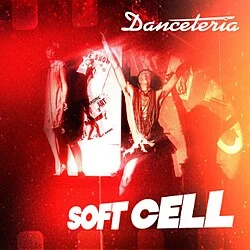
Review: Soft Cell — Danceteria
Music
Soft Cell
Danceteria
Republic of Music
Street: 09.25.2026
Soft Cell = Pet Shop Boys + B-movie aesthetics + glitter and grime
I thought that Soft Cell’s 2022 release *Happiness Not Included would serve as the capstone to vocalist Marc Almond’s and keyboardist David Ball’s partnership. It had been 22 years since the duo’s last album, Cruelty Without Beauty, and just over 40 years since the success of “Tainted Love.”
*Happiness Not Included encapsulated the euphoria of the night before and the comedown of the morning after in a way that perfectly surmised Soft Cell’s mystique. Propelled by a Pet Shop Boys remix of “Purple Zone,” the album reached number one on the UK Dance Album chart and saw the group headlining festivals, embarking on an American tour and visiting Australia for the first time. Soft Cell was fashionable again.
Like an indie horror film that found itself atop the box office chart, *Happiness Not Included demanded a follow-up. Danceteria is a romantic look back to 1982 when Soft Cell were based in New York City. Like many of Almond’s releases, it finds the singer lying in the gutter looking up at the stars. Unlike previous Soft Cell releases, Danceteria is notably missing the enduring cynicism of their previous releases. Some will begrudge the almost-optimism of the nostalgia. I’m inclined to celebrate it. Soft Cell was always counterculture. Warmth in a time of coldness is a bold statement.
Not that there isn’t a sense of sadness that accompanies the album. Ball passed away in October of 2025, just after completing the final mix of Danceteria. Perhaps, by going back to 1982, Soft Cell has created a time distortion where the end always loops back to near the beginning. Soft Cell never fades; their songs become eternal. It works in science fiction, so why can’t it apply to music?
The start of our journey to New York City, 1982, is the instrumental track, “Elusive,” which features a sample of Anita Sarko, a legendary Danceteria DJ, reflecting on the idea that no one is thinking about making history while living in the moment. It’s a cinematic opening that leads to a parting velvet curtain and the discovery of the album’s second track, “Danceteria,” on the other side. It’s a dancefloor romp that sets the scene of bodies swirling around the biggest personalities like planets drawn to the sun. The arrangement is big, bold and bombastic.
“The Space Inside” offers a widescreen look at the shadow people who come out after nightfall. It feels like Almond’s Tenement Symphony updated, relocated and transformed into something new. The narrative is rooted in the past, but Ball’s arrangement isn’t period-specific.
Night gives way to afternoon for the bouncy ballad “Times Square.” Almond leads us through B-movie screenings, a thunderstorm and the general madness that existed before the area’s Disneyfication a decade later. Its daytime sonics are something of an outlier to the neon glow of the rest of the record.
“Two of a Kind” is a downtempo, electro ode to secondhand glamour that would fit comfortably on Almond’s Fantastic Star that serves as a perfect foil to the high-class ballad of “The Rainbow Room,” a love song that abandons the gutter and glitter for skyscraper excess and polish. It’s a touch indulgent — so was the restaurant.
“Decadence is Hard Work” feels like a descent into something sinister as it stomps along with vocoder effects and saxophone frills. You might not find happiness, but cocaine and soul abandonment are included.
Our time in the underworld is rewarded with “In Heaven (When I Dance with You),” the most unabashed pop song on the album. It’s “Danceteria” with the dancefloor lights turned all the way up. There’s a sing-along chorus and a blissfulness that isn’t laced with the traditional sense of loss.
This is followed by “Crackland,” an incredibly upbeat song about buying drugs. It even includes a bit of flute dancing around in the background. In a different time, this would have been controversial. I can’t bring myself to sing along, and that reluctance makes the following track, “What is Your Morality,” feel highly appropriate. It’s a hypnotic mid-tempo track where Almond asks the listener how far they are willing to go down the rabbit hole.
Thematically, the journey continues with “Losing Yourself,” with a lyric that suggests that the abandonment of morality is infinitely more enjoyable than putting yourself together. The sonic palette, however, makes the experience feel more like a nightmare. It’s Pinocchio in Pleasure Island.
Thankfully, the nightmare clears with “After Hours,” a downtempo comedown where the masks fall away and the “creatures of the night” are forced to battle loneliness in the wake of a night of delirious excess. To a great extent, the narrative that started with “Danceteria” ends here.
“Wave to America” feels like the song that plays over the credits. It summarizes the story, brings all the characters on stage for their final bow. It’s up-tempo, overproduced and a perfect close.
But the album doesn’t end there. Maybe it should. The cover of Was (Not Was)’s “Out Come the Freaks” fits thematically, and Nona Hendryx’s backing vocal is inspired, but the space it could occupy is already filled with the superior “Danceteria.” To extend the cinematic metaphor, it’s something of a deleted scene.
Danceteria is unusual in that it sets aside the “misery, complaints, self-pity, injustice” that has been a hallmark of Soft Cell for a sense of romantic nostalgia. It’s still stuck in the gutter, but it feels like they’re finally getting their chance to touch the stars. —Ryan Michael Painter
Read more of Ryan Michael Painter:
The Legendary Herbie Hancock brings six decades of experimental jazz to Red Butte Garden Amphitheatre
Tea in the Tea Garden: Legendary Act Tour for the First Time
Wanna keep up with what’s happening in music here in SLC? Consider joining our community of donors!
