Film Review: The City of Lost Children
Archived
The City of Lost Children
Director: Jean-Pierre Jeunet, Marc Caro
Le Studio Canal+
In theaters: 05.17.1995
It’s my last night of a two week stay in Amsterdam. I’ve done the hash bar thing, perused through every significant collection of the Dutch masters, as well as the higher grade porn shops. I got myself a nice full body massage, and even got caught in the throes of an attempted mugging. It wasn’t until that last night, however, that I saw shit you wouldn’t believe. Something so right it had to be wrong, so deliriously enjoyable that it nearly overshadowed all other experiences in the capital of sin. On that particular night I went to the movie theater to see Jean Pierre Jeunet and Marc Caro’s latest film The City of Lost Children.
If you’re unfamiliar with these French auteurs, I suggest you quit wasting your life away and go watch their first gem, Delicatessen; only then will you understand the mandate behind spending two hours in an Amsterdam movie hut, not to mention tram time and foot travel. The arrival of Delicatessen onto the film scene marked the beginning of a new force in French, as well as world film. It presented the masses with a fantasy vision that stretched the bounds of the genre, promoting the concept of film as a rollicking good time with little social agenda.
The film aimed to please and was built to last, all for a fraction of the cost one would expect. The release of The City of Lost Children comes with slightly less fanfare than its predecessor, yet promotes the same style and visual acuity in order to define the reliability factor of these deux French guys. What they have produced is exactly what you would expect, want them to, and hope they will create for the rest of their working lives. If they were Stephen King, the world would be a better place than it is for entertainment! If it’s escapism and visual delight that brings most audiences to a theater, then The City of Lost Children delivers in spades.
Once again, a world is crafted so that it heightens the base purity of our own while transcending its boundaries through the magic of detail and context. It wants to be classified as a futuristic fantasy, because many of the elements exude a sense of invention and wonder that are alien to our own, yet it occurs in a setting that’s akin to the flavors and aesthetics of the turn of the 19th century. The only true comparison I can think of is Blade Runner, yet even that doesn’t fully hit the mark.
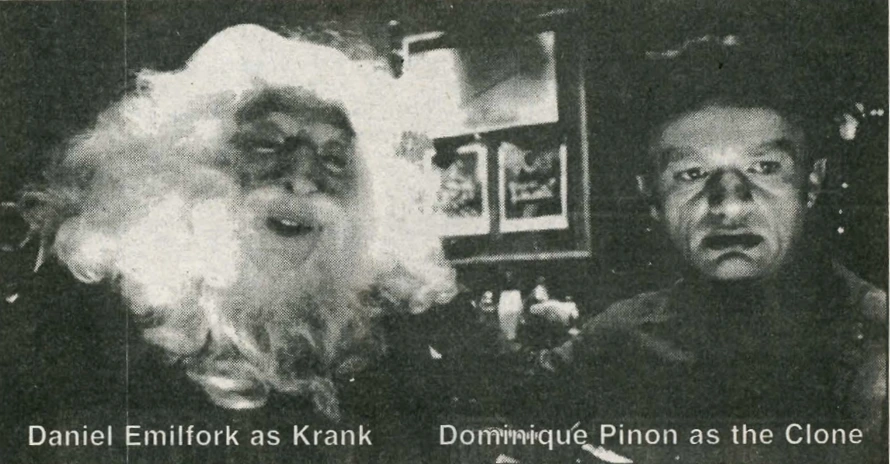
The worlds created by Jeunet and Caro are as singular as any developed on film and based upon this latest, are becoming more and more delightful. The City of Lost Children is a seaside town whose inhabitants live in fear of continual kidnapping that leave no trace. That’s because the children are being whisked away to an oceanic outpost, where a sick old man appropriates their dreams in the hopes that he can experience his lost youth. His only problem is that he cannot find a specimen whose mind is so disengaged as to not fear the grotesqueness of his own body and demeanor.
His endeavor is further complicated by his own creations, including a series of replications and the brain floating in the fish tank. The children of the city are not exactly typical, however. Their level of maturity surpasses that of most of the adults, a result of their servitude to the Siamese twins who oblige them to steal everything of value within the town.
This network of theft runs the gamut of simple pick pocketing to the most elaborate of heists. It’s not until the circus strongman loses his brother that both chains of evil are snapped, and the closest thing to a normal life can continue for the city. Within this context the magic embodied in Delicatessen is elaborated upon by Jeunet and Caro in a purely visual sense. This time they are working with a much higher budget, though still paltry compared to their Hollywood peers, and they used the dollar to it’s maximum effect without compromising the ingenuity and cleverness that inadequate resources can often promote. They have managed to create a scenario that is highly convoluted, yet unabashed in its ability to delight with every turn.
If this were an American venture, it would be the biggest grossing film of the year, but unfortunately it is in French and will have a limited appeal solely because the dialogue appears at the bottom of the screen. Oh, the burden of foreign cinema! No matter how good a movie might be, it never catches an audience the way mindless garbage does. How can I possibly persuade you to see this film when it’s not even in a language you will audibly understand? Well, all I can do is relate my own first experience with the film.
Amsterdam is not progressive enough to dub their movies like the Germans do, so I was fraught with the challenge of watching a French film subtitled in Dutch, complete with all the hoodee hodies and oglie daglies common to that insipid language. I tell you, it mattered nought, and even worked to my advantage in strange ways. Not only was it totally cool to see advertisements for cigarettes and booze before the movie, but the striking imagery throughout the film plugged into the visceral core of my imagination, with the text no longer a slave to structure alone.
I was able to create the story according to motion and emotion portrayed through the inherent qualities of the tremendous cast. It was an odd experience, almost a revelation in film viewing! How else would I ever have thought that the strongman, One (his name is One), would certainly rip the dainty little outfit off the little heroine Miette and pursue the willful corruption of a pre-minor? Not only did I have to call into question the purity of my own mind, but I also had to wonder how many times these Frenchman have been in a criminal lineup for incest cases in France. Whether you read the subtitles or not, I would hope that the experience of viewing The City of Lost Children will be one of the best of the year, and will promise many more similar trips to come. —Ivar Zeile
Read more archived film reviews here:
Movie Review: Cronos: August 1994
Sky Cries Mary
Follow us on Instagram!
