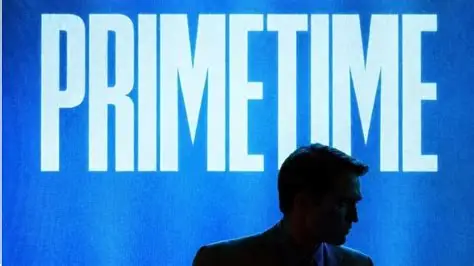
Film Review: Narrative debut Primetime proves Lance Oppenheim isn’t a one-trick pony
Film
Primetime
Director: Lance Oppenheim
A24 Films
In theaters: 09.25.2026
Bill Conradt was a Dallas-Fort Worth assistant district attorney in 2006. Born on January 30, 1950, Conradt had a long and fruitful career up to this point: He had received his law degree from the University of Texas and Texas Tech University and had under his belt a 22-year tenure as district attorney of Kaufman County, from 1980 to 2002. Conradt’s colleagues would describe him as having a “near photographic memory of the law,” and his close friends would describe him as a very reserved man, having never married and properly settled down.
That was Conradt’s social stature prior to November 5 of that year: a socially responsible and reserved man and accomplished district attorney living in Terrell, Texas. And then, on November 5, 2006, at 8:30 a.m., Dateline NBC television crews, led by Chris Hansen of To Catch a Predator fame, were trespassing on his property. Murphy and Terrell Police arrived at Conradt’s home at 2:20 p.m. with search and arrest warrants for Conradt. When Conradt refused to cooperate with police, SWAT teams were brought in. Conradt shot himself with a Browning .380 and died 60 minutes later at Parkland Memorial Hospital.
Collin County’s district attorney decided not to pursue indictments for any of the 23 other predators Hansen caught in Murphy, TX. Perverted Justice, the activist group that Hansen worked with, failed to submit their chat logs as evidence to the court, and Dateline NBC failed to submit their video evidence. A wrongful death lawsuit for Conradt’s suicide was filed to the tune of $105 million, which was resolved for an undisclosed amount of money. It was these events that would result in the abrupt cancellation of Hansen’s To Catch a Predator, and the events that would create the climax of Lance Oppenheim’s Primetime: a dramatization of Hansen’s rise to fame and some of the events that would result in NBC ending its contract with Hansen.
While I do think that Hansen’s journalistic work throughout the airing of To Catch a Predator was sensationalist at best and unethical at worst, one should not discredit the genuine good work that he did. The fact of the matter is Hansen and Perverted Justice *did* get predators off the street, despite the lawsuits and failed indictments. His highly publicized trials of these predators in the court of public opinion, in my mind anyway, did genuinely help reduce crime. In that sense, I think when writing a narrative biopic about Hansen and To Catch a Predator, it is important to toe that line: to criticize Hansen’s journalistic ethics whilst also not detracting from the important things he did. Going into this film, I wasn’t sure if Oppenheim was equipped to create such a nuanced narrative.
After seeing the film, though, I am pleased to say that Oppenheim crafted an engaging chronicle that displays the aforementioned nuance which such a retelling requires, albeit with one caveat: the ending. After Conradt (played by Alex Winter of Bill and Ted fame) commits suicide to the tune of “Seasons of Love” sung by a voice-throwing Skyler Gisondo (Superman, 2025), Hansen (Robert Pattinson, Twilight, The Batman) muses, “What would have happened if I wasn’t here?” The phrase is used throughout the film by Hansen when confronting predators and is reframed here as a thought-provoking introspection on his drive for ratings and vigilante justice. On the surface level, the reframing comes off as very clever, but once given any thought, it proves to be rather tasteless.
So, okay: Let’s humor Pattinson’s Hansen here. What would have happened if he wasn’t there to drive Conradt to suicide? Conradt had already proven he had a predisposition to speaking to children on the internet in a sexual manner, regardless of his decision to back out of meeting with the decoy several times. It’s the fact that he kept coming back to the chat rooms that demonstrates he would have continued this behavior had he not been baited. Would he have mustered up the courage to meet with a minor to solicit sex? Who’s to say? But the fact of the matter is he had an attraction to minors, and Hansen, despite the tasteless and reckless approach, did get him off the internet rather indefinitely.
The ending is quite a shame given how effectively the rest of the film provided that layered nuance. That isn’t to say that it wasn’t quite entertaining. For a testimonial on Hansen, the film focuses quite heavily on the people around him, such as decoy Dan Plum (Gisondo), a theater student looking for paid roles to get his union card, and Andie Bender (Meritt Wever, Nurse Jackie), a composite of the various producers who drove Hansen to prioritize ratings over journalistic integrity. I think the approach was quite well done in this regard; showing the people surrounding Hansen makes the setting feel far more lively, though moviegoers may feel duped by the lack of Hansen. He really plays the role of a Deuteragonist behind the setting itself, while Plum appeared to receive more screen time than Hansen. Pattinson’s Hansen is intense and brooding and really the main attraction of this film despite said lack of screen time. He nails Hansen’s cadence of speaking and shambles about as if his suit is the only thing keeping his limbs together. It’s an incredibly unique character study of the former reporter and one that I’m all for.
A24 has this tendency to produce incredibly artistic films, and it shows here: Oppenheim had assistance in the form of Nathan Fielder and Ari Aster, both of whom have a long and storied history of quality cinematography. The entire film is shot in 16mm film stock, which gives it a blown-out, high-grain look. In theaters, it’s a very aesthetically pleasing faux-IMAX. The shots are saturated and almost overexposed at times, bleeding into one another like a drunken stupor. The crew additionally used a Sony Plumbicon camera tube from the 1980s, creating blurred and bleeding dreamlike sequences for the principal photography. The result is one of the most aesthetically shot films of the year in my mind. The sound design takes a similar approach: warbly, droning analog synthesizers drive the plot forward. Over an hour of soundtrack was put together by Ari Balouzian and Phoebe Bridgers, with droning guitars and ambiance, giving a feeling of dread and primal righteousness in the perfect places.
I loved this movie, and it continued to sit on my mind for the next several days after seeing it; though, ultimately, I feel the same distinction should be made about this film as about Hansen himself. Much like Hansen, this film prioritizes the sensation and spectacle over integrity. It should be treated as a thoroughly researched and aesthetically pleasing character study of Hansen and sensationalist journalism rather than as an accurate retelling of events or a hard-and-fast narrative. It leaves the morals of the plot as up in the air as possible for you to come up with your own conclusion. So what do you think? Was Hansen a good person? Did his means justify the end? I’ve told you my views, but they’re not gospel. Watch the film for yourself and come up with your own conclusion. —Ezra Smith
Read more SLUG film content here: Film Review: Angel and The Badman Film Review: The Social Reckoning – SLUG Magazine
If you enjoyed this film review, consider joining our community of donors!
