
Confronting a Legacy in My Grandfather Charles Manson
Film
When Sophia Maddox discovered in 2022 that her biological grandfather was the infamous Charles Manson, she found herself carrying one of the most infamous family legacies imaginable. Rather than retreat from it, the actress and filmmaker transformed the revelation into My Grandfather Charles Manson, an intimate documentary co-directed by Alexandra Orton, examining generational trauma, family relationships and the search for truth behind one of America’s most notorious names.
“I needed to make something out of a thing that I’d inherited in my lap. There was no alternative,” Maddox says. Manson was the enigmatic cult leader whose followers carried out the 1969 murders of Sharon Tate, Jay Sebring, Abigail Folger, Wojciech Frykowski, Steven Parent, Leno LaBianca and Rosemary LaBianca, in one of the most infamous crime sprees in American history. The story had everything: sex, drugs, rock ‘n’ roll and even a Hollywood setting, leaving a wildly sensationalized cultural imprint. Though Manson didn’t personally commit the killings, he was convicted of orchestrating the murders and spent the rest of his life in prison.
For Maddox, the documentary wasn’t intended to be a true crime story so much as the need to understand her own family. By the end of 2022, Maddox realized filmmaking was the only way she could process the revelation. Storytelling has long been Maddox’s creative outlet. Although she never attended film school, she found her footing by writing, directing and starring in Hart of the Wild Bunch, a short western co-directed by and starring Maddox and her best friend, actress Grace Caroline Curry (Shazam!, Fall). The inspiration came from a lifelong love of the 1969 classic Butch Cassidy and the Sundance Kid. “I just wanted to be in a Paul Newman-type role and gender-reverse the whole thing,” she says. The project became her filmmaking education and led to the founding of Joan of Arc Pictures in 2021.
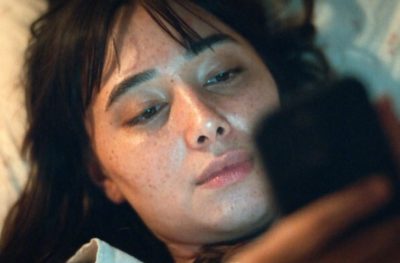
Maddox says she’s long been fascinated by outlaws, citing Cool Hand Luke, Butch Cassidy and the Sundance Kid and Paper Moon, among her favorite films. Learning who her grandfather was, however, gave that fascination a new context. Researching the documentary meant speaking with prosecutors, former inmates and family members to better understand criminal behavior and the systems surrounding it. “As a writer, director and performer, it’s essential that you do that sort of groundwork,” Maddox says.
Throughout the process, and leading up to the film’s June 22 streaming release, Maddox has found herself characterized as a Manson sympathizer or apologist, and it’s a label that she flatly rejects. “I believe he should have gone to prison, and he did,” Maddox says. The film does humanize Manson in the sense that it avoids the “Spawn of Satan” mythos and deals plainly with his abusive upbringing in the juvenile prison system, where even the smallest infractions resulted in beatings with a wooden paddle or leather strap. “I think the case of Charles Manson and making him a monster wrapped it up really neatly in a bow,” Maddox says of the way the story has become a legend. “This guy is evil, and this is why it happened. That wasn’t going to be helpful for me to break generational wounds. I needed to know exactly what I was breaking and what I was really inheriting,” Maddox says, noting that breaking cycles of abuse requires examining the root causes. “We have to look at the complications of humanity,” Maddox says.
While Manson’s name draws audiences to the documentary, Maddox says the emotional heart of the film became her relationship with her loving but deeply troubled father, Daniel Arguelles, who was abused as a child, both by his mother and in juvenile corrections, and never knew who his real father was until he found a half-brother through Ancestry.com. The big picture of their complex relationship, Maddox explains, emerged most clearly during post-production, where therapy sessions and childhood home videos revealed painful patterns she hadn’t recognized before. “I didn’t even remember that childhood car fight,” Maddox says, recalling how old footage unexpectedly echoed dark experiences she’d later have with her father as an adult, who shares Manson’s Hypomania and bipolar disorder. “The worst and the best of my dad is being seen in this movie,” Maddox explains. “And this is very difficult for me to watch. It takes me back to a place that’s not so great. So it was good to have a support system where other people could be in the editing room every day.”
Ultimately, Maddox hopes audiences come away focused less on rehashing the story of the horrific murders and the media frenzy than on mental health, the lasting effects of trauma, and the importance of breaking cycles. “I’ve always wanted to do as much good as I can in this lifetime,” she says. My Grandfather Charles Manson became a way to do that, not only for herself, but by inspiring others to seek therapy and healing.
Read more from Patrick Gibbs:
Jeff Kober’s Big Moment
Clayne Crawford Shares the Secrets of The Agency
To help SLUG continue bringing you inside stories on the latest films, consider becoming one of our donors!
