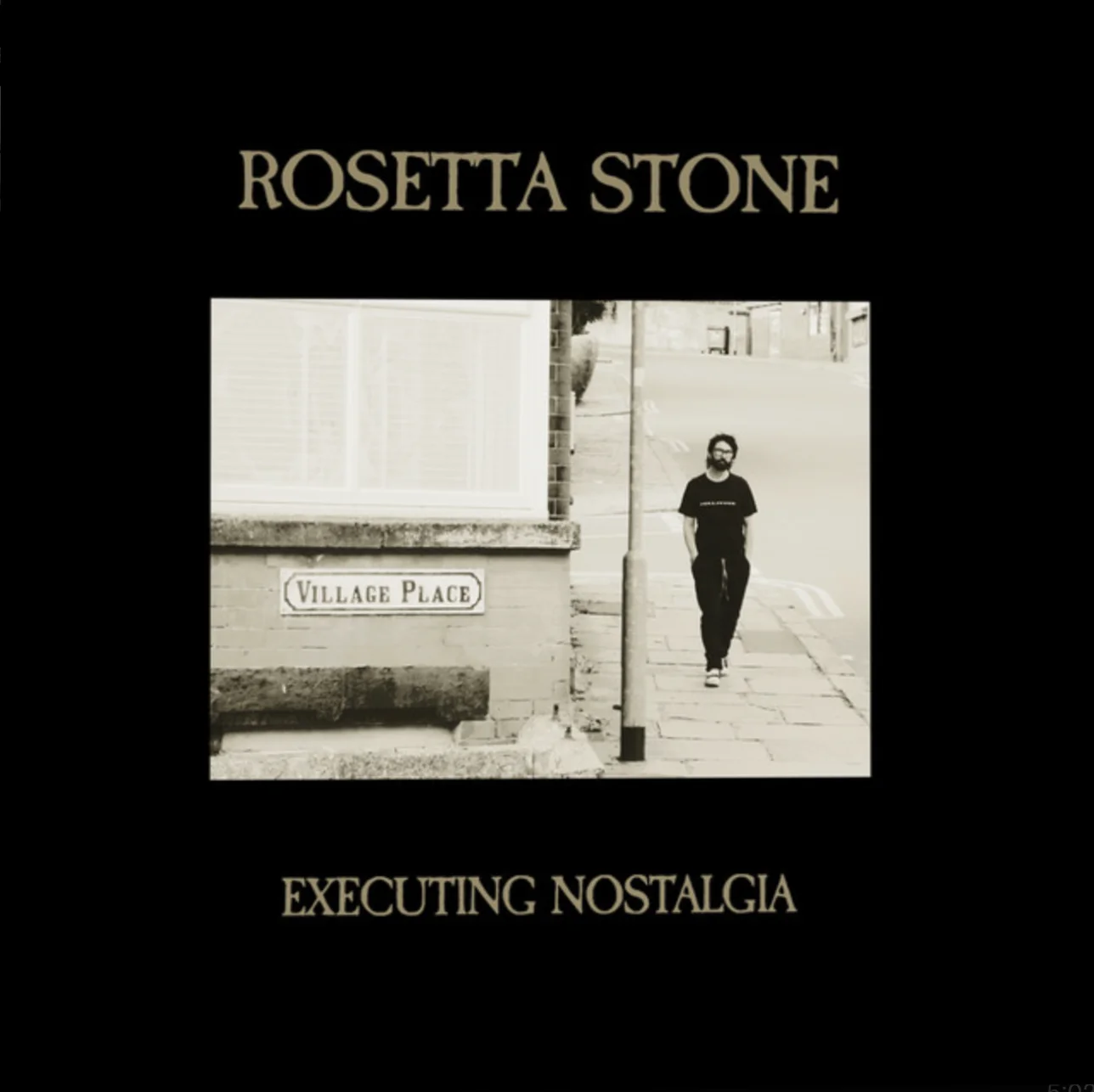
Review: Rosetta Stone — Executing Nostalgia
Music
Rosetta Stone
Executing Nostalgia
Cleopatra Records
Street: 09.25.2026
Rosetta Stone = 55% post punk + 35% darkwave + 10% witch house
Since 2019, when Porl King reestablished Rosetta Stone as his primary music project, I’ve viewed his output as more of an extension of his work as Miserylab rather than a direct continuation of his work with Rosetta Stone in the late 1990s. The key difference is that Rosetta Stone features a more layered production style, while miserylab was focused on minimalism.
King also had a witch house project called In Death It Ends that existed between Miserylab and the resurrection of Rosetta Stone. While I tend to find the genre terribly generic, King’s explorations were genuinely more interesting than his contemporaries. I often wondered what combining the minimal guitar structure of Miserylab might sound like if it was merged with the hypnotic electronic sounds of In Death It Ends.
Executing Nostalgia answers that question as the opening track “Shadowban” offers a catchy, looped hook, layered reverb vocals and nails-on-the-chalkboard guitars. I don’t know that I would have earmarked this as the lead single, but it certainly sets the mood.
“Someone” is more traditional, but there’s a sense of immediacy that pushes the more simplistic arrangement. Lyrically it’s charged by disappointment, a theme that King has revisited often. The religion and mysticism of King’s early lyrics are long since replaced by political and social commentary.
“Regression” is hypnotic and angry with multi-tracked vocals and a heavy focus on the rhythm section. By song’s end the guitar acts more as noise, a series of underlined exclamation marks, than as melody.
The witch house influence is taken even further with the album’s fourth track, “Negative,” with its pounding drums, groove-laden electronics, scratches of guitar and a vocal that sounds like it was recorded underwater in a massive cavern. There’s clearly a chorus and verse, but I couldn’t begin to tell you what the lyrics are. While I do wonder what the track might sound like without the reverb, I can’t help but enjoy it for the chaos that it is.
“Rejection,” the fifth and final original track on the album, is fantastic. What starts with a New Order-vibe quickly transforms into something more akin to The Cure’s “One Hundred Years” with soaring guitars, synthetic strings and King’s sneering vocals. Can we get an extended 12” remix, please?
With the sixth track, the album shifts over to a series of cover songs. The first is a nicely updated version of Xmal Deutschland’s “Incubus Succubus” with guest vocals by Thunder Bae. The production on the track sounds closer to “An Eye for the Main Chance” than anything King has done since 1991.
This is followed by “Pagan Love Song,” the classic Virgin Prunes song. Again, the arrangement is like the original, but King’s voice is radically different from Gavin Friday’s, and the result is more interesting than you might expect.
I don’t know who originally performed “Alone,” but in King’s hands it sounds like a Tubeway Army track recorded in a wind tunnel. That’s intended as a compliment. The guitars are whirling around the vocal, threatening to melt into feedback.
Moving back into familiar territory, the next track is The Southern Death Cult’s “Moya.” Structurally it’s the same as the original, but the guitars and vocals are different. I might prefer the rough edges of the original. Great song, nonetheless.
The album closes with Red Lorry Yellow Lorry’s “Talk About the Weather.” I vastly prefer the Rosetta Stone mix. The original had a wall-of-sound feel that ended up feeling muddy. King’s version is better defined without losing the original’s exasperated vocals.
The first half of Executing Nostalgia is essential listening. It’s the most daring Rosetta Stone has sounded since King resurrected the name, reestablishing the band as an entity looking to push boundaries. I’ve enjoyed the recent releases, but they’ve often felt less progressive, more reflective. In the mid-90s, Rosetta Stone was the most exciting gothic/darkwave/post-punk band because they were willing to experiment. King’s best material comes when he isn’t relying on formulas.
The covers are solid without being essential listening. King’s ’80s covers album, Unerotica, and many of the covers he did in the late ’90s are better examples of his ability to bring mainstream tracks to the dark side. Still, I prefer the production of the new covers to most of the songs that appeared on his 2025 covers album, Is Nothing Sacred. —Ryan Michael Painter
Read more by Ryan Michael Painter:
Review: Soft Cell — Danceteria
Tea in the Tear Garden: Legendary Act Tour For the First Time
Want to help SLUG continue bringing you music reviews? Consider joining our community of donors!
