From the SLUG Archives: Best of the 2000s
Community
Take a trip back to the 2000s with these excerpts from our best stories of each year from 2000 to 2009. Celebrate Kilby Court’s first birthday, hear from Tony Hawk and Rilo Kiley, learn about the history of beer in Utah and more!
Kilby Court!
Issue #140: August 2000
By Brian Staker
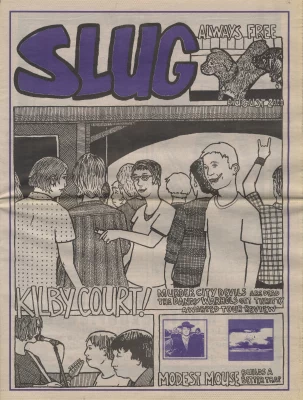
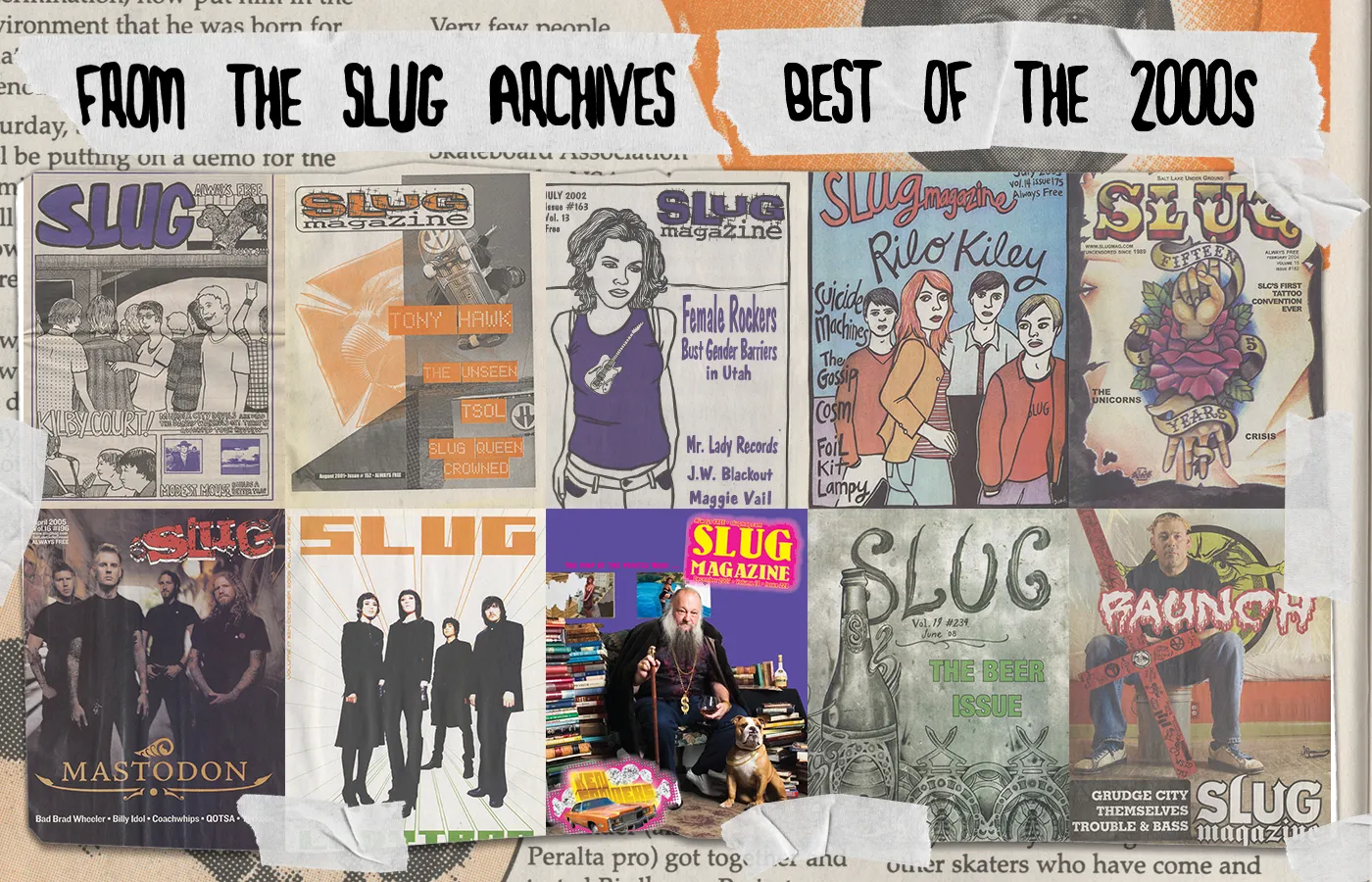
“Without naming names, culturally there is one side and the other,” says owner Phil Sherburne. “A lot of kids don’t fit into the norm. You gotta have somewhere to go, and Kilby’s a great place for people who didn’t find a home with the Young Republicans. Not to mention the great bands that come here.” He continues, “It’s not a clique or anything, but it’s somewhere else to go besides a dance club. These kids think differently. And it’s not just for kids, but for the whole community I hope.”
Kilby Court has been the place in Salt Lake to see an entire array of bands you’d never find anywhere else in this state and one of the few remaining all-ages venues for live music. Visiting bands “appreciate being able to play for a crowd that is actually listening to you, unlike in a bar,” says Rex Shelverton of the San Francisco group Vue. Over 100 shows have happened there since opening almost exactly a year ago on Aug. 9, 1999 with the Pinehurst Kids visiting from Portland. The lineups have read like a who’s who of up-and-coming indie and smaller label rock bands.
Tony Hawk
Issue #152: August 2001
By Mike
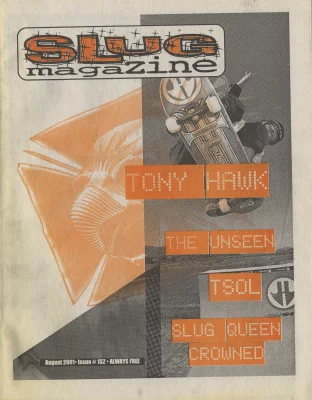
Tony Hawk has been pro for nearly 19 years and officially stopped competing in 1999. At 33 years of age, eating well and skating regularly keeps him healthy. “Having a family and business to manage, I can’t spend all day at the skate park anymore,” Hawk says. When you ride skateboards, injuries are part of the game, and although he says “learning how to fall is the best way to avoid getting hurt,” Hawk has knocked out his front teeth, had a few concussions “before the days of good helmets,” fractured a rib and broken his elbow. Oh yes, the pleasures of skating.
With skateboarding becoming more and more popular and accepted in mainstream culture, Hawk has taken advantage of the hype and used his name to make “much more than I ever thought possible.” He only endorses products that he actually uses or believes in, so don’t think that he’s some sell-out corporate whore. You might have noticed that damn skateboard video game that everyone has been playing, the Tony Hawk Pro Skater game. “It’s amazing that a video game finally makes the general public understand the technical aspects of skating,” Hawk says.
Female Musicians with an Agenda
Issue #163: July 2002
By Joey Marquart
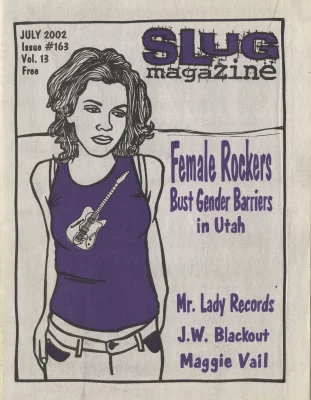
“It doesn’t take a penis to hold a fucking guitar,” says Kelly Green, guitarist and singer for the punk band Teen Tragedies. In a town where roughly one out of every five bands has a female musician — and maybe one out of 10 boasts a female band leader — some girls wonder if playing is a man’s job. “Because I’m a girl, I always have to prove it,” Green says. “But I don’t think my music has anything to do with gender,” she says.
Victoria Johnson, the guitarist and vocalist for the all-girl band The Basement, is used to proving herself. “Male musicians have really low expectations of females,” she says. When a male coworker teased that he’d never met a girl who could do a guitar solo, she called him on it, promising to give him a lesson in female rock on their next break. Liza Law is a tough guitar player whose intelligent lyrics can barely be heard over the hard sounds of Nell Nash, her band. “We’re calling bullshit on these motherfuckers,” she says, when asked about men who don’t take female musicians seriously. “We need to re-learn issues of gender … to redefine what it means to be girls.”
An Interview with Rilo Kiley
Issue #175: July 2003
By Josh Scheuerman
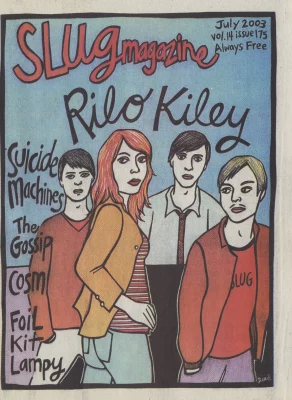
I recognized money and time as both a despairing image and an answer to many of Jenny Lewis’ lyrics in the last two albums. “I think my fears and anxieties take on a different word, face or emotion,” she says. “Those are pretty consistent. I think this new record will have some war references, as I was watching the war on television.” While some artists might scoff at the idea of being political or saying what’s on their mind, this is exactly what many believe being an artist is all about.
“It’s a really scary thing to expose yourself and then scarier to expose your political ideas,” she says. “Personally, I don’t give a fuck. I’m going to say what I want to say and hopefully, the right people will hear, understand and relate to what I’m saying. More than anything else, I’m just afraid for the future of our country. That’s why it comes up in our songs, because I’m scared for my own life.” Lewis has every reason to be afraid for the future of America, but musically, Rilo Kiley already has two astounding releases under its belt and will return for a third this year.
Salt Lake Shows Some Skin
February 2004: Issue #182
By Jennifer Nielsen
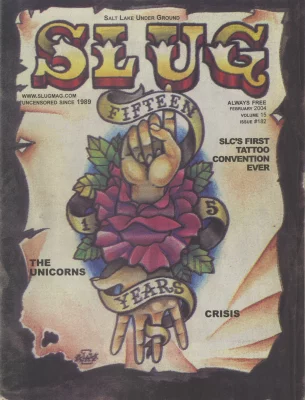
For many individuals living within the Utah state lines, Salt Lake City serves as a sanctuary from an otherwise by-The-Book society. Many members of SLC’s subcultures do abide by a sort of writing, though — that of ink on flesh. You can spot tattooed youth anywhere from Sage’s Cafe and Albee Square to the mall and McDonald’s. Whether you view tattoos as a lifelong symbol of dedication to a movement or a hip fashion statement that will make the girls at East High swoon, the caliber of tattoo artists in SLC rivals that of any major city in the world. That is why, on Feb. 27, 28 and 29, Salt Lake City will be hosting its first-ever tattoo convention.
Put together by Lost Art Tattoo, this year’s convention ain’t gonna be no wallflower amongst the dozens of annual international tattoo conventions. “Ten years ago, this probably wouldn’t have worked,” says CJ Starky of Lost Art. “People weren’t getting sleeves and back pieces — there wasn’t the quality. But at this convention there will be eight international booths from four different continents. We’ve been planning this for a year now, and the time is right. Lots of good shops are thriving.”
Mastodon Has the Ability to Rule Us All
Issue #196: April 2005
By Chuck Berrett
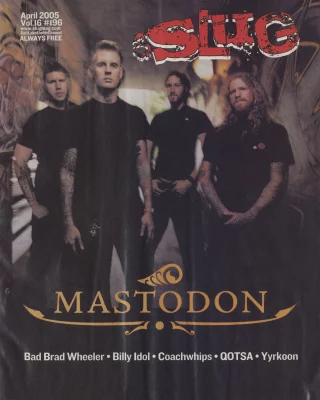
Last year proved to be another year of destroying the planet for Mastodon. Leviathan was released in 2004, an album that is just as complex, indefinable and crushing as 2002’s equally acclaimed Remission. In a conceptual manner, Mastodon re-tells Herman Melville’s tale of Moby Dick. The epic story of a man driven to manic obsession by his hunt for a great yet fictional white whale is just as twisted and gargantuan as the music of Mastodon. Last month, I had the honor of conversing with vocalist and bassist Troy Sanders about his band’s decision to follow the theme of Melville’s novel.
“Well, the story of Moby Dick paralleled the lives of the four dudes in Mastodon so much, it was too easy for us to pick and pull similarities to Captain Ahab’s character and the pursuit of the whale — and the dedication, persistence and sacrifice,” Sanders says. “The longevity of his trip was almost like what we’ve done in our band for the past five years. So we just thought it would be cool to do something themed — not a direct concept album — but something themed with water and creatures, which we’re all fascinated with.”
An Interview with Ladytron
Issue #214: October 2006
By Lynne Scott
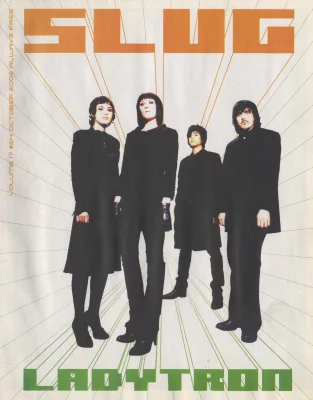
It seemed like a long three years of anticipation for the 2005 Ladytron album, Witching Hour. Rich guitars blending into a harder rock sound was a surprise, yet the band flattened their integrity through the same richness of analog synths and gentle female vocals. Reuben Wu says it was a conscious effort to hold on to the original sound of Ladytron. “There is as much synth as there is on our previous records,” he says. “We’ve just been able to experiment with the sound and broaden our range of instrumentation.”
Adding guitars to Witching Hour came naturally to the band. “We use synths as a foundation and build on top of that,” Wu says. “We don’t try to stay within one realm of instrumentation. It’s all sound. We treat a guitar like a synthesizer, but with strings.” With three out of the four members being DJs, it seemed natural for Ladytron to slip in some vinyl scratching, blending the beats in the vein of Portishead. Wu says they tried, but it was a “bad idea.” What about male vocals? Wu suggests listening very carefully to “International Dateline.” The subtleness of male vocals rewards the listener paying close attention.
Ken Sanders: The Pimp of the Printed Word
Issue #228: December 2007
By Erik Lopez
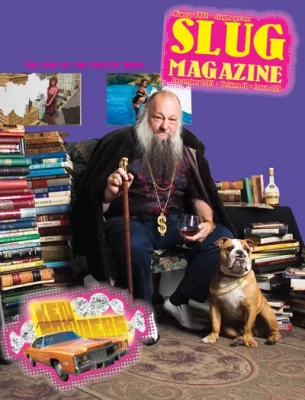
In one form or another, Ken Sanders has been involved with books and the book business his whole life. But the transformation from bibliophile to book seller is as interesting as any printed matter that Sanders sells on his shelves. “I read books omnivorously from the time I could read,” Sanders says. “I don’t ever remember a time when I did not read books.”
Born in 1951, Sanders’ obsession with books started at a young age. At Woodrow Wilson Elementary, Sanders read every book in the school’s library that interested him — from the fantasy fiction of Lewis Carroll to the morose horror stories of Edgar Allan Poe. In class, Sanders would receive boxes of books from the Errol book shipments, which is something like the Scholastic Book Fairs of today. Every week he would get a weekly reader, and every month he would order bunches of 25-cent paperbacks. “[Most kids] would end up getting a book or two. I had more books than the whole rest of the class combined,” Sanders says. “To me, it was a lifeline.” Thanks to his early attachment to books, Sanders became a serious book collector by age 14.
The History of Beer in Utah
Issue #234: June 2008
By Evan Sawdey
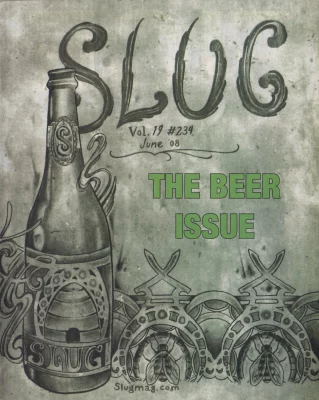
Today, LDS Church members adhere to the Word of Wisdom quite strictly… but it wasn’t always that way. Back when Salt Lake City was in its infancy, the church and its members proved to be both active and vital in the movement to keep Utah soaked in booze. Economically, it was a great way to attract people to Utah’s ever-growing populace.
A Mormon (one that was oft accused of killing people) started the first Utah brewery. Indeed, the infamous Orrin Porter Rockwell established the Hot Springs Brewery and Hotel in 1856. Rockwell himself was a colorful character: He was the personal bodyguard to both Joseph Smith and Brigham Young, and with his Manson-like beard and intense, thunderous eyes, he turned out to be as intimidating as he looked. During a speech given by Vice President Schuyler Colfax in 1869, Rockwell blurted out, “I never killed anyone who didn’t need killing.” This certainly makes sense when you take into account the fact that he was arrested for the murders and attempted murders of multiple men, including notable Western figures such as Lilburn W. Boggs, Lot Huntington and John Aiken.
The Rebirth of Raunch Records
Issue #252: December 2009
By Ryan-Ashley Workman
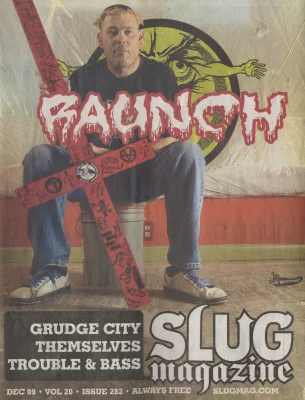
Brad Collins is going full-on with the resurrection of Raunch Records, knowing all too well what a financial gamble it may be. His reasoning is not for any kind of “get rich quick” aspirations, and he acknowledges that others may question the intentions of this business endeavor. “There’s been a couple guys that are going, ‘You’re a dope! What are you doing it for?’” Collins says. “As far as the [current] economy goes, most people are saying, ‘You’re crazy!’ Even the distributors that sell the music are saying I’m crazy … I’m 52 fuckin’ years old. Am I going to relate to the 16-year-old [customers]? I’m not sure yet.”
Raunch Records opened its first location on July 4, 1984 on the corner of 400 South and 400 West. The building that housed Raunch would soon after be known as Positively Fourth Street, which was also the home of rehearsal studios and the legendary Painted Word all-ages music venue, which brought in most cool, touring bands of the time if the neighboring Speedway Café couldn’t accommodate them. It was in the worst part of town at the time, hidden by a now non-existent overpass, just south of Pioneer Park.
Read other articles from the SLUG archives:
Waking up with Jimmy Valle: The Album Leaf’s New Dawn Instrumentalism
The Zach Hammers Interview: The Most Underground Skater Ever!
