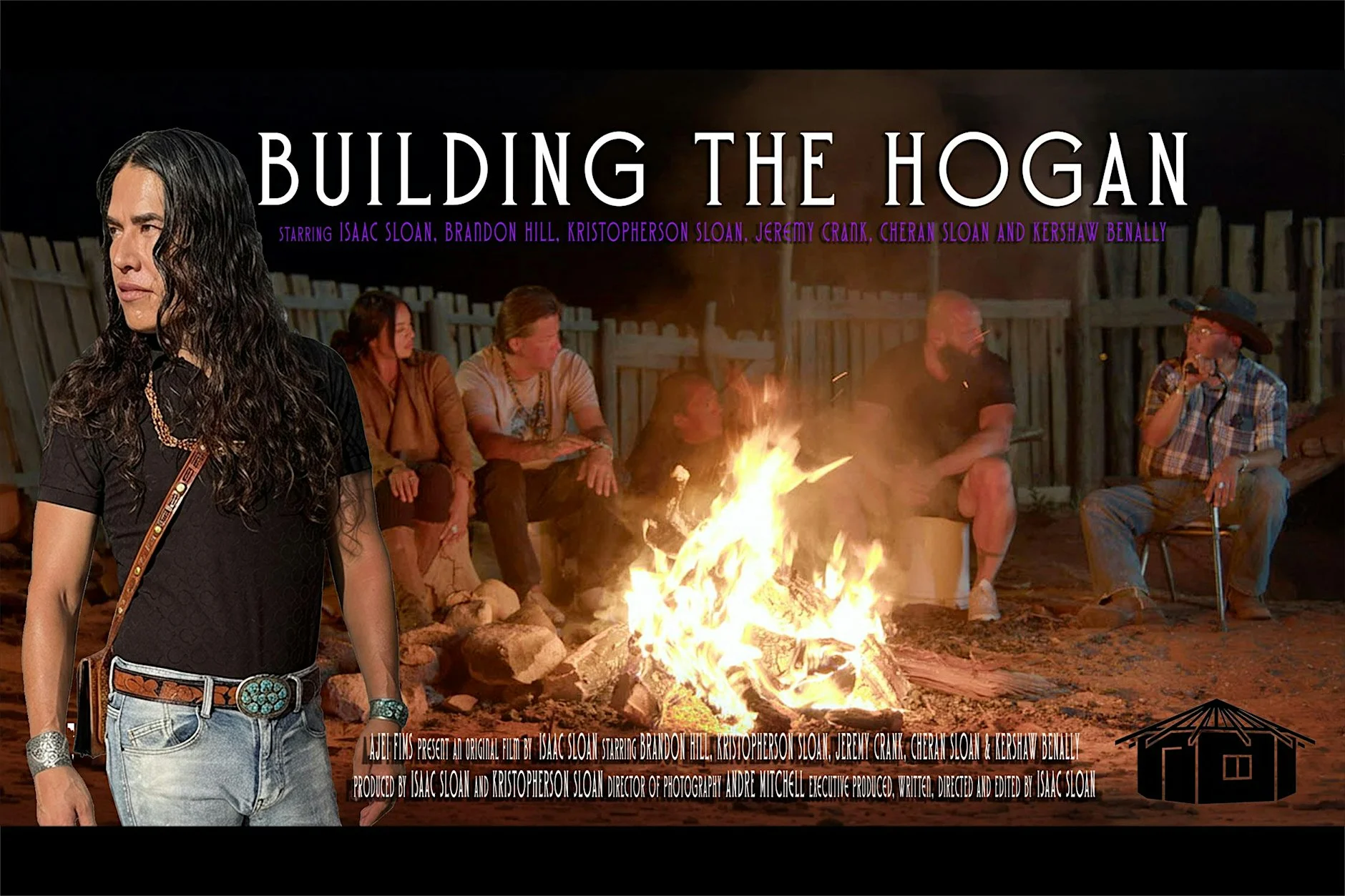
Building the Hogan: A Film Rooted in Family, Connection and Indigenous Communities
Film
Salt Lake City filmmaker Kristopherson Sloan’s Building the Hogan is the kind of comedy where a man can accidentally convince his neighbor that he has murdered five people, give away $1,000 he desperately needs, steal gas from teenagers – and still somehow end up doing the right thing. The film follows Eagle, a lovable but chaotic Salt Lake City troublemaker as he travels to the reservation to help build a hogan for a ceremony. Along the way, Eagle picks up an unlikely group of companions, turning a simple trip into an absurd road adventure.
Sloan calls the film a “contemporary Indigenous comedy that is based on life.” For Sloan, transforming experiences and characters rooted in reality into a film felt like “writing in your journal and finally painting the pictures to go with it.” Eagle embodies that philosophy. He is, Sloan says, “this fun-loving character everybody loves,” someone who is “constantly doing good but kind of leaving a trail of destruction behind him.” His misadventures form the film’s comedic backbone, but beneath the chaos is a character motivated by a compulsive desire to help people. Even when his solutions create new problems, Eagle simply assumes he will fix them.
That sense of familiarity extends beyond Eagle. Sloan recognizes real people in the film’s characters and situations, while the ensemble reflects the communities surrounding the filmmakers, bringing together Native American, Hispanic and African American characters and incorporating Navajo, Spanish and English. The film’s movement between Salt Lake City and the reservation is particularly personal for Sloan. He describes the two places not as opposing worlds, but as parts of what he calls a “dual existence.” Sloan spent his school years in Utah and his summers on his family’s ranch on the reservation, where he herded sheep and cattle and worked alongside his grandfather, a medicine man and tribal leader. That experience informs the movie’s portrayal of reservation life. “We just wanted to be real about it,” Sloan says, hoping to give audiences a better understanding of a place often distorted by assumptions. “They’re just the same as everybody else. There’s just a different existence, just because of the necessity of it.”
For Sloan, however, the film’s most meaningful connection is the one behind the camera. He and his brother grew up inseparable before a falling-out kept them from speaking for roughly 15 years. They eventually found their way back to one another through filmmaking. “It was so amazing for me to have my brother back in my life and to do this thing together,” Sloan says. Their previous film, The Forever Story, was the project that pulled Sloan into filmmaking through his brother. He arrived on set expecting to do hair and makeup and discovered that his brother had actually brought him in to direct. The experience became a crash course that prepared him for Building the Hogan, where Sloan served as a co-writer, co-producer and collaborator while coordinating more than 30 people across Utah and Arizona. Sloan explained the difference between the two films as striking. The Forever Story explores reincarnation, soulmates, karma and destiny while Building the Hogan is more grounded in the messy absurdities of everyday life. However, both share the brothers’ commitment to original storytelling and connection through film. Sloan says, making Building the Hogan was “always what I wanted to do. I wanted to make a film with my people, my friends and my family.”
That sense of community gives Building the Hogan its heart beneath all the chaos. The film may follow Eagle’s unpredictable journey to construct a hogan, but Sloan and his brother have built something of their own: a movie rooted in family, culture, friendship and the stories that connect people across the city and the reservation. –Hannah Larson
Read more film interviews:
The Buzz Around Angelina LookingGlass and The Rivals of Amziah King
Murderbot Composer Amanda Jones Is a Music Making Machine
To help SLUG continue highlighting the local arts, consider joining our community of donors!
